
Game 1, Tuesday October 22. As the series opened in Houston, both teams had their aces on the mound—Max Scherzer for the Nationals and Gerrit Cole for the Astros. Trea Turner opened the series with a single, then promptly stole second (thus satisfying the criteria for a free taco promotion). But Cole set down the next three in order.
The Astros opened their half of the first with a seven-pitch walk by George Springer. José Altuve followed with a single. Scherzer then struck out Michael Brantley and Alex Bregman, but Springer advanced to third on a wild pitch and Altuve stole second. Yuli Gurriel then hit a double to drive in both runners and put Houston up 2 to 0.
In the second with two outs, Ryan Zimmerman hammered a fastball over the center field fence for the first World Series home run in Nats franchise history. The Nats were now trailing 2 to 1.
In the top of the fourth, Juan Soto led off and drove a fastball at the top of the zone high above the left-field wall to land on the railroad tracks, tying the game.
Meanwhile, Scherzer was struggling with command and getting out of jams. He allowed a walk in the bottom of the second and two singles in the bottom of the third, but got out of trouble each time. In the bottom of the fourth, Yordan Álvarez led off with a single. One out later, with Josh Reddick at bat, Scherzer and the Nats caught a break when the umpire failed to call catcher’s interference on Kurt Suzuki, which would have given Reddick a free base. Instead, Reddick flied out for the second out. Scherzer then walked Springer but got the third out from a grounder by Altuve.
In the top of the fifth, Suzuki led off with a walk, followed by a single from Víctor Robles. Suzuki advanced to third on a Turner fly ball, then Adam Eaton singled to drive him in and advance Robles to second. Anthony Rendon grounded into a fielder’s choice, forcing Eaton at second while Robles advanced to third. Then Soto hit a two-out douible off the left-field wall, scoring both runners. The Nats now led 5 to 2.
Scherzer had his first one-two-three inning in the bottom of the fifth, but with his pitch count up to 112 and having battled with command all evening, his night was done. He gave up 2 runs, 5 hits, and 3 walks in 5 innings of work, with 7 strikeouts. Uncharacteristically, he threw 47 balls along with 65 strikes. It was now up to the bullpen.
Patrick Corbin pitched the sixth. It took him 21 pitches and he gave up a single but got out of the inning with the lead intact. Tanner Rainey pitched the seventh and gave up a lead-off home run, followed by two walks, while only getting one out. Daniel Hudson came in and gave up an infield single before getting out of the inning. The Nats led 5 to 3 after 7.
Meanwhile, Cole had pitched two more scoreless innings, making it to 7 innings. He ended his start having given up 5 runs on 8 hits and 1 walk, while striking out 6. Neither pitcher had a great start, but Scherzer managed to get out of all but one of his jams and avoided giving up the long ball.
Hudson went back out for the eighth and gave up a lead-off single, followed by a one-out double by Springer that drove in a run. The Nats’ lead was now 5 to 4. After getting Altuve to line out for the second out, Sean Doolittle came in for a four-out save. He retired all four batters he faced, and the Nats won Game One 5 to 4.
The press focused on Soto, who hit a home run, a double, and a single, stole a base, and drove in 3 of the Nats’ 5 runs. Joe Posnanski of The Athletic wrote that it’s time to stop saying that Soto is the future. He’s the present.
Game 2, Wednesday October 23. Both teams have three pitchers who would qualify as the aces of most MLB teams. For the second game, Stephen Strasburg was matched against Justin Verlander.
The Nationals got on the board quickly. Turner led off the game with a walk, then Eaton singled and Rendon doubled, driving both runners in. The Nats were ahead 2 to 0.
The Astros got those runs back in the bottom of the first. After a strikeout by Springer, Altuve doubled but was caught by a nice throw from Suzuki when he tried to steal third. Brantley then singled and Bregman hit a home run, tying the game at 2 runs each.
For the next five innings the game was a pitching nail biter, which you may not have guessed if you only saw the final score. The Nats got runners on base—a single by Suzuki in the second, a double by Soto in the third, an infield single by Zimmerman in the fourth, and a single by Turner and a walk by Rendon in the fifth—but were unable to drive them in. Strasburg retired the side in the second, had runners reach on an error and a single in the third, and allowed singles in both the fourth and the fifth innings.
In the sixth inning with his pitch count mounting, Strasburg got in his first real jam since the first. Gurriel hit a one-out double, and after Strasburg fell behind Álvarez 2–0, he was intentionally walked. Davey Martinez stuck with Strasburg, who got Carlos Correa to pop up and struck out Kyle Tucker to get out of the inning. Strasburg’s night was over after 6 innings and 114 pitches. He gave up 2 runs on 7 hits and 1 walk, while striking out 7.
Verlander, who was at 98 pitches, went back out for the top of the seventh. Suzuki led off and hit the second pitch into the stands, giving the Nats a 3–2 lead. (Ken Rosenthal of The Athletic wrote a nice appreciation of Suzuki.) Verlander then walked Robles and was pulled for Ryan Pressly. Then the floodgates opened.
Turner drew a walk, and Eaton bunted to advance the runners to second and third. Rendon got the second out on a fly to short center field, not deep enough to score Robles. The Astros intentionally walked Soto, loading the bases with two outs. Howie Kendrick hit an RBI infield single off the end of Bregman’s glove. While not a routine play, the Gold Glove finalist probably would tell you he should have made it, but the Nats were now up by 2. Asdrúbal Cabrera then hit a single on a soft liner to center, driving in two more and putting the Nats up by 4. A wild pitch advanced Cabrera and Kendrick to second and third, then Zimmerman hit a dribbler toward third. Bregman shouldn’t have thrown the ball—Zimmerman was clearly going to be safe—but Bregman launched his throw and two more runs had scored. The game had turned into a laugher, with the Nats leading 8 to 2.
After that, the only question was whether the Nats bullpen would hold the lead. Fernando Rodney got through the bottom of the seventh unscathed, allowing only a walk. In the top of the eighth, Eaton hit a two-run homer, and another run scored after a walk by Soto and a pair of singles by Kendrick and Cabrera, making it 11 to 2. In the bottom of the eighth, Rainey retired the side.
In the top of the ninth, Michael A. Taylor hit a solo home run for the Nats’ 12th run. Javy Guerra finished the bottom of the ninth. With one out, he gave up a solo home run, then with two outs a pair of Astros reached on an error and a single. But he got Jake Marisnick to ground out to end the game. The Nats won 12 to 3 and were taking a two-games-to-none series lead back to Washington.
Game 3, Friday October 25. The World Series was back in Washington DC for the first time since 1933. The Nationals’ crowds were great for all three games—got to the games early, cheered loudly and enthusiastically, and mostly stayed until the end—even though the team never gave them a lead or a really pivotal play.
For Game 3, Aníbal Sánchez squared off against Zack Greinke. In the top of the first, Springer reached on an infield single. Altuve then hit a long drive into center, but Robles made a leaping catch to save a run, and Sánchez set down the next two batters to get out of the inning. In the bottom of the first, Rendon hit a two-out double, but the Nats weren’t able to score him.
The Astros went ahead in the second inning on a double by Correa followed by an RBI single by Reddick. Reddick took second when Soto air mailed the throw home. The Nats tried to get the run back when they led off the bottom of inning with a pair of singles, but Suzuki struck out and Robles hit into an inning-ending double play.
Altuve led off the third with a double, then advanced to third when Soto failed to cleanly field the ball. Brantley followed with an infield single that scored Altuve, giving the Astros a 2–0 lead. In the bottom of the third, the Nats loaded the bases on a single and two walks, but Cabrera struck out to end the threat.
Sánchez retired the side in the top of the fourth. The Nats’ got on the board in the bottom half when Zimmerman walked and Robles hit a triple. With one out and a runner on third, Sánchez came to the plate. Modern analytics said that it was time to put in a pinch hitter, but Martinez, not trusting his bullpen, left his pitcher in. Sánchez struck out on a foul bunt, and Turner grounded out, stranding Robles. Sánchez’s subsequent pitching would not live up to his manager’s expectations.
The Astros extended their lead to 3 to 1 in the fifth on an Altuve double followed by a Brantley single. In the bottom of the inning, Eaton led off with a single and Cabrera advanced him to third with a two-out double. Astros manager A.J. Hinch pulled Greinke for Josh James, who struck out Zimmerman to end the threat.
In the top of the sixth, Eaton made a spectacular catch to get the first out. Robinson Chirinos hit a one-out solo homer, and then Sánchez walked Tucker. Martinez brought in Rodney. Sánchez had gone 5-1/3 innings and had given up 4 runs on 10 hits and 1 walk, getting 4 strikeouts. Rodney walked Springer, the first batter he faced, but managed to get out of the inning after Tucker got caught in a run-down between second and third, and Bregman grounded into a fielder’s choice.
In the bottom of the sixth, Parra pinch hit for Suzuki, giving the national tv audience a chance to see Nats fans celebrate “Baby Shark.” We later learned that Suzuki had suffered a right hip flexor injury while catching a Rodney pitch, and Suzuki would be out the rest of the series (though he was not dropped from the roster). Parra struck out, but Robles and Matt Adams drew one-out walks. Then Will Harris came in and set down Turner and Eaton.
Joe Ross pitched a one-two-three top of the seventh, and Harris retired the side in the bottom of the inning. Ross got three more outs in the eighth, allowing only an infield single. The Astros brought in Joe Smith for the eighth, and he got three outs while giving up a single by Kendrick.
For the top of the ninth, Wander Suero pitched and retired the side. Roberto Osuna closed the game for the Astros. Eaton got a one-out single, but Rendon fouled out and Soto struck out to end the game. The Nats fell 4 to 1.
I don’t especially like talking about the strike zone, but it became an issue in game 3 and remained one for the rest of the series. (Fortunately, I don’t think it was ever decisive for a game, though it did affect several important plays.)
Gary Cederstrom was behind the plate in Game 3. He was giving pitches on the outside corner to Greinke, but giving the Astros batters the benefit on low pitches by Sánchez. It was most egregious in the fifth inning, when the Astros were leading 2 to 1. Brantley came to bat with one out and Altuve on second. With a 1–1 count, Sánchez fired a pitch into the bottom of the zone, but it was called a ball. He threw another pitch, and it again hit the bottom of the zone, but it was called ball 3. The next pitch was up, and Brantley singled to make it 3 to 1.
But Cederstrom was unfair to Sánchez the entire game. This image from a story by CBS Sports shows the strikes zones called for Sánchez versus Greinke. Greinke got several strikes called outside the zone, whereas Sánchez had balls called for pitches inside the zone.
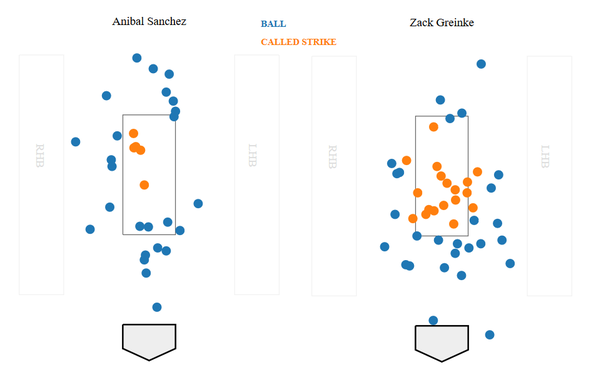
We know that Suzuki is not good at pitch framing, but these differences are so extreme it almost leads me to wonder if someone in MLB might have hinted to Sederstrom that they’d prefer not to have the series turn into a sweep.
The Nats’ offense had opportunities. They had 14 batters reach base (on 9 hits and 5 walks), but went 0–10 with runners in scoring position and stranded 12 runners. This was a game that should have been much closer than it was.
Game 4, Saturday October 26. The Nationals were starting Corbin, whose 3.25 ERA and 238 strikeouts in the regular season made him the team’s third ace, though his 6.91 ERA in 6 previous post-season appearances was a cause for concern. The Astros countered with José Urquidy, a rookie whose entire major league experience consisted of 41 innings in 9 regular season games and 4 innings in relief in 2 post-season games.
Corbin quickly got into trouble in the first. After striking out Springer, he gave up four consecutive singles, putting the Astros ahead 2 to 0. After another walk to load the bases, he finally got out of the jam when Chirinos grounded into a double play.
In the bottom half of the first, Rendon hit a two out single, but Soto lined out to end the inning. Corbin and Urquidy each retired the side in the second. In the third, Corbin got the first out thanks to a tremendous diving stop by Rendon. He then gave up a single to Brantley but got Bregman to pop up and struck out Gurriel. In the bottom half, Yan Gomes led off with a double, but the Nats were unable to bring him in.
In the fourth, Corbin walked the lead-off hitter. Then with a 1–0 count, he served up a belt-high change-up to Chirinos who hit it into the stands. The Astros now led 4 to 0. Urquidy retired the side in both the fourth and fifth, as did Corbin in the fifth and sixth. Corbin was helped with the first out in the top of the fifth by an amazing diving play by Robles to catch a line drive off the bat of Brantley.
Urquidy was taken out after 5, but he had dominated the Nats’ lineup, allowing no runs on 2 hits and no walks, while striking out 4. Corbin, in contrast, went 6 but gave up 4 runs on 7 hits and 2 walks, while striking out 5. As Andy McCullough of The Athletic reported, “The Astros weren’t fooled by Corbin’s slider.”
In the bottom of the sixth, the Nationals finally got on the board when Parra and Eaton drew walks and Rendon hit a one-out infield single. Soto grounded out to first, scoring a run. But then Kendrick struck out to end the inning. The Astros led 4 to 1.
Rainey got the call in the seventh. After giving up a walk to Tucker, he had Springer facing a 3–2 count. Tucker took off and Gomes came up on what could have been a strike ’em out/throw ’em out play, but the umpire incorrectly called it ball 4 and gave the Astros another base runner. Rainey got Altuve to fly out, but then Martinez inexplicably brought in Rodney. Despite past glories, Rodney is not a pitcher you should turn to in a high leverage situation, especially when he pitched the previous day. (With 0 days rest, his opponents’ OPS this season was .865.) Rodney gave up a single to Brantley, followed by a grand slam home run to Bregman. The Astros were now up 8 to 1. Then Martinez let him load the bases with three more walks (with a fielder’s choice mixed in) before Martinez finally pulled him for Suero.
After that, the game was pretty uninteresting. The Nats had two runners reach in both the seventh (on a single and a walk) and the eighth (on an Astros throwing error and a walk) but didn’t score them. Guerra pitched the eighth and ninth and gave up two hits in each inning, but no runs. In the ninth, Soto gunned down Chirinos trying to score (in contrast to his bad throw home in the second inning of Game 3).
The Nats were retired in the bottom of the ninth, with only Dozier reaching on a two-out walk. The Astros won Game 4 decisively, 8 to 1. The Nats stranded 9 runners and were 1 for 9 with runners in scoring position. The home town team left the stadium disappointed for the fourth consecutive night.
Joe Posnanski of The Athletic wrote about how the Nats were old-fashioned and not aggressive enough.
Game 5, Sunday October 27. We were expecting a rematch between Scherzer and Cole, so Nats fans were shocked in late afternoon to learn that Scherzer would not be able to start due to neck spasms. Ross would would get the start—the Nats’ fifth starter facing perhaps the best pitcher in baseball. Scherzer would get cortisone shots and was hopeful to return later in the series.
Springer drew a walk from Ross to lead off the game, but Altuve grounded into a double play and Brantley grounded out. Cole retired the side in the bottom of the first.
In the second, Ross gave up a one-out walk to Gurriel, then Álvarez drilled a home run to left center field. When the ball hit a fan in the chest who was holding onto two beers, the video went viral. The Astros were ahead 2 to 0.
In the bottom of the second, Soto and Kendrick led off the inning with a pair of singles and the Nats had runners on first and third with no outs. But Cole struck out Zimmerman and Robles grounded into a double play, ending the Nats’ opportunity.
In the third, Ross worked around a two-out single, while Cole retired the side. Trouble came in the fourth, when Álvarez hit a two-out single. Ross got ahead 0–2, then hit the corner for what should have been called strike 3, ending the inning. But Lance Barksdale called it a ball, and four pitches later Ross hung a slider over the center of the plate and Correa hit it over the fence. Astros were up 4 to 0, and Barksdale’s mistakes were just beginning.
In the bottom of the fourth, Cole worked around a one-out walk to Rendon, and both pitchers retired the side in the fifth. Ross was finished after five, and actually had pitched pretty well. He really only made one bad pitch, the home run to Correa. The sinker that Álvarez hit out was a good pitch on the outer corner that the hitter managed to drive. Ross gave up 4 runs on 5 hits and 2 walks, striking out 1. Unfortunately, he was no match for Cole.
In the sixth, Rainey came in and faced Brantley. Brantley a 2–2 pitch that caught the strike zone and Gomes stood up to throw the ball around. But Barksdale called it a ball and told Gomes he was taking off on him. Gomes responded, “Oh it’s my fault?” and Martinez was going crazy. This mistake was obvious but didn’t affect the game, as Rainey retired all three Astros that inning. In the bottom of the inning, Cole also retired the side. In the seventh, Doolittle gave up a lead-off single, but the runner was erased on a double play. After a walk, Doolittle struck out Cole to end the inning.
With one out in the bottom of the seventh, Soto took Cole deep to left-center. The Nats now trailed 4 to 1. Kendrick struck out for the second out, but Zimmerman drew a walk on a 3–2 pitch on the corner. Cole hollered a Barksdale—it was a pitch he had been getting the call on earlier (though we’ve seen that Ross hadn’t gotten a similar call earlier). Then Robles worked the count to 3–2 and took a pitch clearly out of the zone, a couple of inches farther outside than Zimmerman’s pitch had been. He started toward first thinking he’d brought the tying run to the plate, but was called out by Barksdale. I hate it when umpires try to make up for previous bad calls by making a bad call in the opposite direction, but I think that’s exactly what happened there. Overall, Barksdale’s strike zone was extremely erratic, and there were a number of articles calling for robo-umps.
Hudson came in for the eighth and gave up a lead-off double to Springer. Altuve grounded out but advanced the runner. After an intentional walk and a fly-ball out, Gurriel singled to drive in Springer and give the Astros their four-run lead back. It was 5 to 1.
Smith pitched the bottom of the eighth and gave up a lead-off single to Gomes, but he retired the next three in order. Hudson stayed on for the ninth and gave up a one-out single. Then Springer hit a two-out homer, putting the Astros up 7 to 1. Suero came in to get the final out.
Pressly pitched a one-two-three inning in the bottom of the ninth, and the Nats’ home stand was over. They lost the game 7 to 1 and trailed in the series, 3 games to 2. In contrast to the first two games, where the Nats had plenty of batters reach but failed to drive them in, this time they stranded only 4 runners and were 0 for 2 with runners in scoring position. In contrast to Game 1, this time Cole had simply dominated them.
The other notable event in Game 5 was that President Trump attended the game. His presence went largely unnoticed until it was time for the regular 3rd inning salute to the troops when the scoreboard switched to show the President. The crowd immediately switched from cheering the troops to booing the president. A little later there were chants of “lock him up.”
Game 6, Tuesday October 29. Back in Houston, the Nats would now need two consecutive wins. Replaying the match-up in Game 2, Strasburg squared off against Verlander.
Turner led off the first with an infield single. Eaton bunted him to second, and Rendon drove him home on a single to center. The Nats were up 1 to 0.
The lead was quickly reversed, though, when Springer hit a lead-off double, advanced to third on a wild pitch, and was driven in by a sacrifice fly from Altuve. One out later, Bregman hit a home run to left. In celebration, he carried the bat all the way to first base and tried to drop it off in the coach’s unwilling hands—an act that did not go unnoticed by the Nationals players. The Astros led 2 to 1. After the game, we learned that the Nats’ coordinator of advanced scouting realized that Strasburg had been tipping his pitches and had Paul Menhart correct the problem between innings
Both pitchers retired the side in the second. In the top of the third, Eaton and Rendon each drew two-out walks, but Soto grounded out to end the inning. Strasburg again retired the side.
In the fourth, Kendrick led off with a single, then Zimmerman drew a one-out walk. But the runners were stranded after a strikeout and a fly-out. In the bottom half, Strasburg surrendered two two-out walks on 9 pitches, but managed to strike out Correa to get out of the inning.
In the fifth, the Nats finally got to Verlander. With one out, Eaton drove a slider over the right field fence. With two outs, Soto launched a mammoth home run into the second deck. Trolling Bregman, Soto also carried his bat down to first. The Nats were now leading 3 to 2.
In the bottom of the fifth, Strasburg gave up a one-out single to Reddick followed by a double to Springer. But he struck out Altuve and got Brantley to ground out to get out of the jam. In the sixth, Peacock came in and retired the Nats in order. Strasburg gave up a lead-off single but retired the next three.
The top of the seventh would be the turning point of the game, but first it featured the most controversial call of the series. After Gomes hit a lead-off single, Turner hit a dribbler in front of the mound and raced toward first. Peacock fielded it and rushed his throw toward first, pulling Gurriel’s glove into Turner. The ball got away, and the runners advanced, but home plate umpire Sam Holbrook called Turner out for interference. I’ll talk more about the rule below, but it led to a heated argument and an 8-minute delay while the called New York to clarify if the rule had been applied appropriately. (The play could not actually be reviewed, as it was a judgment call.) Later, between innings and presumably after Martinez had seen some video, he came out to argue the Turner interference call again and was ejected from the game.
After the long interruption, Harris replaced Peacock and got Eaton to pop out. Then Rendon caught a cutter in the middle of the plate and hit it into the left-field stands. The Nats were up 5 to 2, and the interference call on Turner had been rendered moot.
Strasburg, who seemed to only be getting better as the night went on, retired the Astros in order in the seventh and the eighth. Pressly set down the Nats in order in the top of the eighth.
The Astros brought in Chris Devenski for the top of the ninth, and he got two outs. Then Turner doubled, Eaton was hit by a pitch, and Rendon hit a doujble off the wall in deep right, driving in both runners. He had 3 hits and 5 RBIs that night, and the Nats now led 7 to 2.
In the bottom of the ninth, Strasburg came back out to face one more hitter. He got Gurriel to line out, then Doolittle came out for the final two outs. Álvarez lined out for the second out, then Correa hit a double. But Chirinos popped out to end the game. The Nats won 7 to 2 and the series was tied at three games apiece. We were going to have a Game 7.
Strasburg’s game was amazing. He threw 104 pitches and 65 strikes. In 8-1/3 innings, he gave up 2 runs on 5 hits and 2 walks, and struck out 7. (His game score was 70.) His game, along with Cole’s Game 5, were the best starts of the series.
The interference call on Turner.
The relevant part of the rule in question [5.09(a)(11)] is:
A batter is out when:
(11) In running the last half of the distance from home base to first base, while the ball is being fielded to first base, he runs outside (to the right of) the three-foot line, or inside (to the left of) the foul line, and in the umpire’s judgment in so doing interferes with the fielder taking the throw at first base, in which case the ball is dead; …
Rule 5.09(a)(11) Comment: The lines marking the three-foot lane are a part of that lane and a batter-runner is required to have both feet within the three-foot lane or on the lines marking the lane. The batter-runner is permitted to exit the three-foot lane by means of a step, stride, reach or slide in the immediate vicinity of first base for the sole purpose of touching first base
A few comments:
- After the game, Joe Torre made clear that according to the rules Turner was called out for interfering with the play, not for running outside the 3-foot running lane.
- Did Turner actually “interfere with the fielder taking the throw at first base”? It didn’t look like he was “running into Gurriel’s mitt as the ball was arriving.” Rather, it looked to me like Gurriel was moving his glove into Turner while attempting to catch an off-line throw. The rule says the batter is out if he “interferes with the fielder taking the throw,” which I interpret as taking action that interferes, not just being there when a throw goes off course.
- If Turner was called out for interfering with the fielder, why would Sam Holbrook, the home plate umpire, be the one to make the call? He’s in position to see the running lane, but that only becomes relevant if it’s established that the batter has interfered with the fielder taking the throw. I’d think the first base umpire would be the one best positioned to see and judge if interference took place. After interference is established, then I’d think the first-base umpire would consult with the home-plate umpire about the running lane, if that turns out even to be relevant.
- According to the rule’s “Comment”, the batter has the right to be outside the 3-foot lane while taking his last step toward the bag. Turner was clearly taking that last step when the alleged interference took place. The path Turner had previously taken doesn’t seem relevant to what was happening when the alleged interference took place.
- The purpose of the rule establishing the 3-foot running lane is to allow the catcher a clear throw to the base for a ball fielded directly in front of the plate. But Turner’s hit was fielded near the pitcher’s mound. Peacock’s throwing line was not obstructed by Turner’s running path. He just made a bad throw that veered Turner rather than going directly to Gurriel.
- For a right-handed batter, getting into the 3-foot running lane and then making a final step from foul territory to the base in fair territory would be an unnatural path, maybe even dangerous. As Turner said, the batter’s box is in fair territory and the base is in fair territory, so the most direct path is along the fair side of the line. (Interestingly, when this rule was first written, first base was apparently placed in the middle of the foul line rather than on the fair side, allowing players to step on first without veering into fair territory.) If baseball rules are designed to get players to follow them, this rule seems like a non-starter as few right-handed batters follow this running path and enforcement of this rarely applied rule seems unlikely to get them to change their path. Furthermore, it’s not clear that getting them to do so would improve the game in any meaningful way.
- The rule is not consistently applied. Craig Edwards of FanGraphs notes calls on several similar plays that went the other way and were even protested and upheld. I’m sure I’ve seen a number of similar plays over the years where interference wasn’t called. An erratically enforced rule that suddenly is applied in the biggest games of the year is a recipe for disaster.
- The rule, as applied in this case as well as similar cases, rewards bad fielding. That’s not good for baseball.
It’s a bad rule and needs to be changed. Get rid of the 3-foot lane and just tell batters they have to follow a direct running lane toward the base, the same as with any other base. If there’s purposeful interference such as knocking the ball out of a glove, call it, but don’t call out the runner just for being in the path of a bad throw.
Game 7, Wednesday October 30. Three days after missing a start in excruciating pain, Scherzer was feeling good and would get the start. How well would he pitch and how long could he go? Facing him would be Greinke, who had been hittable in Game 3, though he limited the Nats to 1 run in 4-2/3 innings. Cole, with two days rest, lurked in the Astros bullpen.
In the top of the first, Greinke set down the Nats in order. Scherzer got through the bottom half, only giving up a two-out walk to Brantley. In the top of the second, Soto led off with a single but was quickly erased when Kendrick hit into a double play.
Leading off the bottom of the second, Gurriel took a slider low in the zone into the Crawford Boxes, putting the Astros up 1 to 0. Álvarez and Correa followed with a pair of singles, but Scherzer got the next three outs to avoid further damage.
Scherzer continued to allow base runners—a single and a walk in the third, a single and a walk again in the fourth, but kept them from scoring. Meanwhile Greinke set down the Nats in order in the third and fourth and worked around a walk in the fifth.
In the bottom of the fifth, Brantley led off the inning with a single. Scherzer struck out Bregman, and Gurriel grounded into a fielder’s choice. But Álvarez drew a walk, and Correa singled, scoring Gurriel. The Astros now led 2 to 0. After 103 pitches, Scherzer’s night was done. In 5 innings he had given up 2 runs on 7 hits and 4 walks, with only 3 strikeouts. It wasn’t a characteristically great Scherzer performance, but he had made it through 5 innings and the Nats were still in the game.
In the sixth, Greinke again set the Nats down in order. Through 6 innings, he had held the Nats scoreless while allowing only 1 hit and 1 walk. Furthermore, when the Nats put the ball in play, many of them were weakly hit. Greinke fielded 5 come-backers to the mound (including one that started a double play). He seemed to be baffling the Nats batters.
Martinez called on Corbin to pitch the sixth. He gave up a lead-off single, but got a strike out and a double play to retire the side.
Hinch stuck with Greinke in the top of the seventh, and he got Eaton to ground out to start the inning. Then Rendon caught a change-up near the middle of the zone and hit a home run. The Nats exhaled as they realized they could get to Greinke.
Soto drew a walk, catching a break on a 2–1 pitch that was called a ball but should have been a strike. Hinch decided it was time to go to his bullpen and brought in Harris. (He would never call on Cole.) On an 0–1 count, Kendrick caught a cutter on the bottom, outside corner of the plate and sliced it into the right field corner. It hit the foul pole screen and the Nats were suddenly ahead 3 to 2.
The Nats extended their lead in the eighth when Eaton drew a one-out walk, stole second, and was driven home on a two-out single by Soto. They were ahead 4 to 2.
Meanwhile, Corbin had things under control. He worked around a two-out single in the seventh and retired the side in the eighth. He pitched 3 scoreless innings, giving up only 2 hits and striking out 3.
In the top of the ninth, the Nats added on. After two singles and a walk, the bases were loaded for Eaton with one out. He singled to center, driving in two, and the lead was 6 to 2.
Finally, it was the bottom of the ninth, and Hudson came in to finish the game. Long-time Nats fans were trying not to remember Game 5 of the 2012 NLDS or Game 2 of 2014. But Hudson needed only 12 pitches to get a pop-up from Springer followed by strikeouts by Altuve and Brantley. The Nationals were champions! And for the first time ever, the road team had won every game of a seven-game series.
The Nationals were favorites. The Nats had better starting pitching and a stronger lineup. But the Cardinals had been hot in the second half, had a Cy Young candidate in Jack Flaherty, and hoped that the games could get to the bullpen, where they held the advantage. It turned out the Nats’ starters were up to the challenge and the bullpen did its part, as the Nats swept the series.
Game 1, Friday October 11. It was a cold evening in St. Louis, about 45 degrees at game time. Aníbal Sánchez started for the Nationals, while the Cardinals countered with Miles Mikolas. The Nats struck first, when Howie Kendrick led off the top of the second with a double to deep right-center. Two outs later, Yan Gomes hit a double to the left-center gap, scoring Kendrick and putting the Nats up 1 to 0.
In the bottom of the inning, Marcell Ozuna squared up on a cutter and drove it to deep center where Michael A. Taylor caught it on the warning track. On a warmer night it might have been a home run. It turned out to be the only time the Cardinals would barrel a ball that night. Sánchez mixed up his seven pitches and hit his spots, resulting in weak contact and a lot of soft fly balls.
In the fourth, the Cards got their first base runner when Sánchez walked Kelton Wong. Wong stole second and advanced to third on a throwing error by Gomes. But Ozuna fouled out to end the inning.
In the fifth, the Nats managed to load the bases on two singles and a walk but were unable to score a run. In the sixth, Ryan Zimmerman hit a one-out double but was left stranded. In the bottom of the sixth, Cardinals pinch hitter Randy Arozarena was hit by a pitch and stole second. He made it to third before Sánchez got Wong to fly out, ending the inning. Sánchez had not allowed a hit. Meanwhile, Mikolas had also been quite effective, pitching 6 innings and allowing one run on 7 scattered hits and 2 walks (one intentional) while striking out 7. It was still 1 to 0.
In the top of the seventh, Giovanny Gallegos was pitching for the Cards, and Adam Eaton hit a one-out triple. Rendon was intentionally walked, and Andrew Miller was brought in to face Juan Soto, who struck out. Then the Cards brought in John Brebbia to face Kendrick, who singled to drive in Eaton and increase the Nats’ lead to 2 to 0. In the bottom of the seventh, Sánchez hit Molina with a pitch but set down the other three batters. He was at 89 pitches after seven innings with a no-hitter still intact.
In the bottom of the eighth, the Tommy Edman led off with a line drive toward first. Zimmerman made a diving catch to snag the ball and keep the no-hit bid alive. After another fly ball out, José Martínez came in as a pinch hitter and hit a short line drive to center that landed for a single, ending the no-hit bid after 7-2/3 innings. Sean Doolittle came in to get the last four outs. He retired all four batters he faced on three ground outs and one strikeout. The Nats won 2 to 0.
Daniel Hudson missed the game that evening but was making some history by becoming the first player to use the paternity leave list in the postseason when he went home for the birth of his daughter. The paternity list had been introduced for regular season games in 2011, and was extended to postseason games in 2016 after Blue Jays reliever Aaron Loup missed some games for the premature birth of his son. Of course a few Neanderthals criticized Hudson for missing the game, but the Nationals defended him. Doolittle was quoted, “If your reaction to someone having a baby is anything other than, ‘Congratulations, I hope everybody’s healthy,’ you’re an a–hole.” Jeff Passan of ESPN wrote a nice article describing Hudson’s experiences.
Game 2, Saturday October 12. It was warmer that it had been the previous evening, but Game 2 was a late afternoon start (3:08 Central time, 4:08 Eastern) that meant the batters and fielders would be battling sun and shadows for the first five or six innings. Max Scherzer took the mound for the Nationals, while Adam Wainwright pitched for the Cardinals.
The Nats offense struck in the top of the third when Taylor, leading off the inning, hit the first pitch into the left-field seats, giving the Nats a 1–0 lead. Other than that, the first six innings of the game were a pitcher’s duel. Besides the Taylor home run, the Nats scattered three singles: by Rendon in the first, Taylor in the fifth, and Trea Turner in the sixth. Meanwhile, Scherzer had held the Cards to two walks and had a no-hitter through six. It was the second time in postseason history that two pitchers had held opponents hitless for 5+ innings in consecutive starts—repeating what Sánchez and Scherzer had previously done for the Tigers in the first two games of the 2013 ALCS.
In the seventh, Wainwright retired the Nats in order, but Scherzer gave up a single to Paul Goldschmidt, ending his no-hit bid. He then struck out Ozuna and got Yadier Molina to ground into a double play, ending the inning. In 7 scoreless innings, Scherzer struck out 11 while giving up 1 hit and 2 walks.
In the top of the eighth, Matt Adams got a one-out pinch-hit single, and Turner followed with another single. Eaton then doubled, driving in two runs and increasing the Nats’ lead to 3 to 0. Wainwright was pulled after 7-1/3 innings and had struck out 11 and given up 3 runs on 7 hits and 1 (intentional) walk.
Doolittle pitched the bottom of the eighth. He struck out Matt Carpenter, then Eaton made a leaping catch of a hard-hit ball from Edman. With two outs, Doolittle gave up a single to Paul DeJong. Then Martínez hit a line drive to center that Taylor misplayed, allowing the Cardinal to score their first run of the series. Doolittle retired Dexter Fowler to get out of the inning.
In the bottom of the ninth, Patrick Corbin came in for a lefty-lefty match-up and got Wong to ground out. Then Hudson retired Goldschmidt and Ozuna, and the Nats won 3 to 1. They left St. Louis leading the series two games to none.
Game 3, Monday October 14. Nationals Park was full and the crowd buzzing as Stephen Strasburg took the mound against Jack Flaherty, the Cardinals ace. The Cardinals threatened first, when Ozuna led off the second with a double. But then Ozuna got caught between second and third when Martínez grounded one back to Strasburg, who ran him down for the fielder’s choice. The Cards weren’t able to take advantage after the base running miscue.
In the top of the third, Rendon made a great play to rob DeJong of a hit. The Nats struck in the bottom of the third. Víctor Robles, returning to the line-up after missing several games with a hamstring injury, led off with a single, and Strasburg bunted him to second. After a Turner strikeout, Eaton singled to drive in Robles. Then Rendon doubled, driving in Eaton. Soto walked, and both runners advanced on a wild pitch. Kendrick then doubled, driving in both runners and putting the Nats up 4 to 0.
The Cardinals pinch hit for Flaherty in the top of the fifth. In the bottom of the fifth, Rendon got a one-out single off Tyler Webb. Brebbia came in to face Kendrick with two outs and Howie doubled, driving in Rendon. Zimmerman followed up with another double, plating Kendrick and putting the Nats up 6 to 0. In the bottom of the sixth, with Brebbia still on the mound, Robles hit a home run to right-center to make it 7 to 0.
Through six innings, Strasburg had held the Cardinals scoreless on 4 hits and no walks, while striking out 9. He was at 90 pitches. The Cardinals led off the top of the seventh with a pair of singles by Martínez and Molina. Strasburg stuck out Edman, then DeJong singled to left. Martínez held up at third until Soto slipped and threw the ball away, which allowed Martínez to score. Strasburg struck out Matt Wieters and Dexter Fowler to get out of the inning. Strasburg’s line for the game was 1 unearned run in 7 innings on 7 hits, no walks, and 12 strikeouts.
In the bottom of the seventh, Kendrick hit a two-out double and Zimmerman drove him in. It was now 8 to 1. Fernando Rodney set down the Cardinals in order in the top of eighth, striking out two. Tanner Rainey finished the game in the ninth, retiring all three batters with two strikeouts. The Nats were now one win away from clinching the pennant and making it to the World Series for the first time in franchise history.
Game 4, Tuesday October 15. It was Ted Lerner‘s 94th birthday. Patrick Corbin was pitching for the Nats, and Dakota Hudson was on the mound for the Cardinals. Corbin struck out the side in the top of the first. Then things started going crazy in the bottom of the inning.
Turner opened the inning with a single to right, and Eaton followed with a double. Rendon hit a sacrifice fly to center to score Turner. Soto then slashed a double into the left field corner, driving in Eaton. Kendrick was intentionally walked, and Zimmerman grounded to third baseman Edman in what should have been the second out, but secon baseman Wong dropped the ball allowing Kendrick to reach second safely and loading the bases. Robles then lifted a short fly into right that had three Cardinals converging but not communicating with each other, and they let it drop in for a hit. With better fielding that would have been the third out, but now it was 3 to 0 with the bases still loaded and one out. Gomes laced a single past the shortstop into left field, plating two more runs. Wainwright came in to relieve Dakota Hudson, and Corbin sacrificed to advance Robles and Gomes to second and third. Then Turner hit another single, driving in two more runs. After one inning the Nats led 7 to 0.
That was it for Nats scoring, as the Cardinals’ bullpen limited the Nats to 3 singles and a walk the rest of the night. Meanwhile Corbin was dealing in the early innings. By the time he recorded his eleventh out, with two outs in the bottom of the fourth, he had struck out 9 while giving up only a single and a walk. The next batter, Molina, however, took Corbin deep and made it 7 to 1.
In the fifth inning, perhaps Corbin was tiring or the Cardinal batters were getting used to his repertoire. Harrison Bader led off with a walk, and Wong singled him to third. Fowler, pinch hitting, drew another walk and the bases were loaded with no outs. Edman grounded out, driving in a run and advancing the other runners to second and third. Martínez then doubled, driving in two more runs and narrowing the Nats’ lead to 7–4. Corbin struck out Goldschmidt and Ozuna to get out of the inning, but the game was now a lot tighter.
Rainey pitched the sixth and set down all three batters. Doolittle retired the side in the seventh on 9 pitches. He came back in the eighth and retired Martínez and Goldschmidt, but gave up a single to Ozuna. It was time for Daniel Hudson to try to get the last 4 outs.
First Hudson had to get himself out of some trouble, as he hit Molina then walked DeJong, loading the bases with two outs. He managed to get out of the jam without giving up a run, though, when Carpenter grounded out. In the ninth Hudson set down the side in order, with the final out coming on a fly ball to center that was caught by Robles. The Nats won the game 7 to 4 and swept the series.
The series MVP award went to Howie Kendrick, who led the team in runs, runs-batted-in, and extra-base hits (with 4 of each). The Nationals starters as a group were outstanding. The Cardinals hit .141 against the Nats starters, the lowest average ever allowed by a starting rotation in a best-of-seven postseason series. And the bullpen was excellent too, allowing only a single run in 9-1/3 innings of work. Many players contributed to an outstanding series.
The Los Angeles Dodgers were the better baseball team. You might argue that their starting rotation didn’t quite match that of the Nationals, but if that was the case, it was only by the narrowest of margins. Their batters hit 279 home runs, compared to 231 by the Nats. Their bullpen was very good (ranked third in the NL in FIP– and fourth in ERA–), whereas the Nats’ bullpen was awful. They led MLB in defensive runs saved. Their bench was deep and versatile, allowing the team to swap players in and out and gain the platoon advantage.
But despite obvious weaknesses, the Nationals were well suited to upset the 106-win Dodgers in a five-game series. And by repeatedly coming back from behind and “staying in the fight” until the 10th inning of Game 5, that’s exactly what they were able to do.
Game 1, Thursday October 3. With Max Scherzer and Stephen Strasburg having piggy backed to get the win in the Wild Card Game two days earlier, the start for Game 1 in Los Angeles went to Patrick Corbin. Whether he was nervous or was just struggling for command, Corbin issued four walks in the first inning and gave up a run. After that, Corbin settled down and allowed just two singles over the next three innings. In the bottom of the fifth, after striking out the first two batters, Corbin gave up a walk and infield single, placing runners on first and third. He then got Muncy to hit a ground ball that Howie Kendrick was unable to field. It was Kendrick’s second error of the game and put the Dodgers up 2 to 0. Meanwhile the Nats were unable to get anything going against Buehler. Leading off the second, Juan Soto hit a single but was doubled off on a lineout. In the fourth, Buehler gave up three walks but got out of his bases loaded jam. Both starting pitchers went six innings turned it over to their respective bullpens with the Dodgers leading 2 to 0.
Then we got to compare the two teams’ bullpens. The Dodgers brought in Kolarek, a lefty sidewinder, to get Soto out, then Maeda set down five Nats in a row. The Nats had Tanner Rainey face three batters in the seventh; he gave up a walk and a single and was followed by Fernando Rodney, who also gave up a walk and a single before recording the final out. The Nats now trailed 4 to 0. Hunter Strickland got the call in the bottom of the eighth and gave up two home runs.
In the top of the ninth, Trea Turner hit a leadoff double off Joe Kelly—only the Nats’ second hit of the game—before Kelly set down the next three Nats in order. The Nats were throughly outplayed In the 6–0 game, and all of their deficiencies were exposed.
Game 2, Friday October 4. The loss in Game One made it critical for the Nats to win Game Two to avoid falling into a deep hole. The pitching match-up was Strasburg against Kershaw. Trea Turner opened the top of the first with a double. After Adam Eaton popped out, Anthony Rendon walked and Soto was hit by a pitch, loading the bases. A single by Kendrick put the Nats ahead 1 to 0. Then Ryan Zimmerman fouled out and Kurt Suzuki struck out, so the Nats weren’t able to further capitalize on a very shaky first inning by Kershaw.
In the second inning, Víctor Robles was hit by a pitch to lead off the inning, and after two outs Eaton singled and Rendon doubled, increasing the Nats’ lead to 3 to 0.
Meanwhile, Strasburg was dominating the Dodgers. He got them out on strikeouts (10 total) and groundouts and didn’t allow a base runner until Will Smith singled with two outs in the bottom of the fifth. Strasburg had pitched three innings in relief in the Wild Card game on Tuesday, so we wondered how long he could last. With one out in the bottom of the sixth, fatigue finally seemed to catch up, as he gave up a single to Beaty and a double to Pederson, followed by a sacrifice fly to Justin Turner. He got out of the inning with lineout to the pitcher, but the Nats’ lead was now 3 to 1.
In the bottom of the seventh, Sean Doolittle took over in relief and struck out Bellinger, but then gave up a home run to Muncy before getting out of the inning. The score was now 3 to 2.
Meanwhile, the Nats hitters were challenging the Dodgers’ bullpen—Báez, Kolarek, May, and Urías—which had taken over in the top of the seventh. Trea Turner and Eaton led off the top of the seventh with singles but were left stranded. In the eighth, Zimmerman’s led off with a double, and Suzuki followed with a walk. Asdrúbal Cabrera singled to drive in Zimmerman, widening the Nats’ lead to 4 to 2. In the eighth inning Robles had to leave the game with a hamstring injury—Michael A. Taylor would take his place in center for the rest of the series.
In the bottom of the eighth, Scherzer was called in to pitch an inning of relief on his “throw day.” He struck out the side. In the bottom of the ninth, Daniel Hudson was called on to get a two-run save. Justin Turner led off with double, but Hudson then struck out Pollock and got Bellinger to pop out to Rendon on a play that actually turned out to be fairly difficult. With two outs and a runner on second, Davey Martinez called for Muncy to be intentionally walked, putting the tying run on base. Hudson then walked Smith on four pitches, loading the bases. After throwing seven straight fastballs away to Seager, Hudson came in with a slider and Seager swung through it, giving the Nats the win.
The decision to issue the intentional walk to Muncy caused the predictable consternation among the analytical community. Joe Posnanski of The Athletic makes the case against the move with his usual elegance, while Ben Clemens of Fangraphs goes through the numbers in excruciating detail (or wonderful, depending on your tastes). My own take is a little more relaxed. With two outs, the Nats’ win probability was very high regardless of the intentional walk—we’re talking 94% without the walk versus 90% with it. The pitcher has one out to get, and if he really feels much more comfortable not facing Muncy, I’m willing to let him face the batter he’s comfortable going after.
Game 3, Sunday October 6. With the series moving to Washington for Games 3 and 4, Aníbal Sánchez faced off against MLB’s ERA leader, Hyun-Jin Ryu. In the top of the first, the Dodgers loaded the bases on a single and two walks, but Sánchez worked out of the jam. In the bottom of the first, Eaton walked and Soto homered, giving the Nats a 2–0 lead. Both pitchers then settled settled in. The Nats led off the bottom of the fourth with a pair of singles, but a double play squelched any rally. In the top of the fifth, Muncy homered to make it 2–1.
Corbin came in in relief in the top of the sixth. He gave up a lead-off single to Belinger and followed it with two strikeouts. Then Freese came in as a pinch hitter and singled. Corbin got ahead of Martin 0–2, but the Dodgers catcher evened the count, then doubled into the left-center gap. The Dodgers went ahead 3–2. Things got worse. Corbin walked Chris Taylor and gave up a double to Kike Hernández, making it 5–2. Wander Suero came in to try to stop the bleeding but immediately gave up a homer to Justin Turner, making it 8–2 Dodgers.
In the bottom of the sixth Kelly was pitching for the Dodgers, and the Nats tried to get back into the game. Rendon and Soto drew walks, followed by a single by Kendrick. Suddenly the bases were loaded with no outs. Kelly threw a wild pitch, and Rendon scored with Soto and Kendrick advancing. Yan Gomes walked, loading the bases again, still with no outs, and when Urías replaced Kelly on the mound, Cabrera came in as a pinch hitter. He hit a fly ball to right, scoring Soto on a sacrifice fly, but when Kendrick tagged to advance to third he hesitated, then failed to return to second, allowing the Dodgers to easily double him up on the way to third. Rather than one out and two base runners, the Nats now had two outs and only a runner at first. The Nats now trailed 8 to 4. Michael A. Taylor popped out to end the inning, but Kendrick’s base running gaffe had killed the rally.
The rest of the game was fairly uneventful. Rodney got into a bases loaded jam in the top of the seventh, but was able to get out of it unscathed. In the top of the ninth Strickland gave up a two-run homer to Martin. Meanwhile, the Dodgers bullpen shut down the Nats’ offense, and game ended as a 10 to 4 triumph for the Dodgers.
Game 4, Monday October 7. Down two games to one, the Nats would need two consecutive wins to salvage the series. Scherzer took the mound for Game 4 facing Rich Hill.
In the top of the first, Scherzer gave up a two-out solo homer to Justin Turner, and the Dodgers jumped to an early 1–0 lead. In the bottom of the third, the Nats evened the score when Rendon hit a sacrifice fly to drive in Taylor. Hill, who was on a short pitch count, left before the end of the inning, and the Dodgers turned to their bullpen.
In the bottom of the fifth with Urías pitching, Trea Turner led off with a single. Eaton sacrificed him over, and Rendon singled to drive him in. The Nats were up 2 to 1. Soto popped out, but Kendrick singled to place runners on first and third with two outs. Báez relieved the left-handed Urías, but Martinez decided to stick with the right-handed Zimmerman rather than going to a left-handed pinch hitter. On the second pitch, a fastball above the top of the zone, Zim got under it and drove it to center for a home run, putting the Nats up 5 to 1.
The Nats added another run in the bottom of the sixth on a Rendon sacrifice fly. Meanwhile, Scherzer managed to shut down the Dodgers after the first inning home run. In the seventh inning, starting to run on fumes, he gave up a single and two walks to load the bases with one out. But Martinez left him in and Scherzer struck out Taylor. Pederson hit a foul ball that came within a couple of inches of being a three-run double, but Scherzer managed to get a ground-out to end the inning. In 7 innings he allowed 1 run on 4 hits and 3 walks, striking out 7.
Doolittle came in for the top of the eighth. The first batter he faced, Muncy, drove a ball into deep center, but a strong wind blowing in knocked it down for Taylor to catch. Doolittle set down all three batters in eighth and also got the first out in the ninth. Hudson came in to get the last two outs, and the Nats won 6 to 1.
Game 5, Wednesday October 9. Back in Los Angeles for the finale, Strasburg was facing Buehler. For the first couple of innings, Strasburg was unable to command his curveball, allowing the Dodgers to sit on his fastball. Pederson led off with a double, followed by a Muncy two-run homer. Leading off the second, Hernández hit a solo home run, and the Nats were down 3 to 0.
Buehler held down the Nationals, and Strasburg settled down and held down the Dodgers. In the top of the fifth, Suzuki led off with a walk followed by a Taylor single. Strasburg was unable to bunt them over, though, and Buehler set down Turner and Eaton to get out of the inning. In the sixth, Rendon led off with a double, followed by an RBI single from Soto, and the Dodgers’ lead narrowed to 3 to 1.
Leading off the top of the seventh, a Buehler fast ball ricocheted off Suzuki’s wrist and hit him in the face, and Suzuki fell to the ground. He was pulled from the game, but we later learned that the injury wasn’t as bad as we initially feared. Buehler got two outs, then walked Trea Turner, and Roberts called in Kershaw to face Eaton. Eaton struck out, and the Dodgers held onto their 3 to 1 lead.
Strasburg had gone six innings and pitched quite well after the two early home runs. His final line was 3 runs on 6 hits and 1 walk in 6 innings, striking out 7. Rainey pitched the bottom of the seventh and retired both batters he faced, then Corbin was called on to retire the lefty Pederson.
Roberts decided to keep Kershaw in to face Rendon and Soto in the top of the eighth, a decision for which he was subsequently vilified. In three pitches, Kershaw gave up home runs to both Nationals hitters, and the game was suddenly tied 3 to 3. Maeda was brought in and got the next three Nats out. Corbin pitched a scoreless bottom of the eighth and Kelly set down the Nats in the top of the ninth. Hudson pitched the bottom of the ninth, and despite a hard hit fly ball by Smith that had the Dodgers prematurely ready to celebrate, Hudson got out of the inning only giving up a single.
Roberts left Kelly in for the top of the tenth, and Eaton led off the inning with a walk. Surprisingly not bringing in Jansen, the Dodgers’ erstwhile closer, Kelly stayed in and gave up a double to Rendon. Soto was intentionally walked, and Kendricks came up with the bases loaded and no outs. After fouling off a curve, Kendrick drove a fastball into deep center for a grand slam, giving the Nats a 7 to 3 lead. In one blow, Kendrick redeemed the three fielding errors and the base running gaffe that had previously tarnished his series record.. In the bottom of the tenth, Doolittle got a strikeout and a groundout, then Michael A. Taylor made a diving catch on a Justin Turner fly ball to end the game and give the Nationals their first-ever NLDS victory.
The Dodgers had outscored the Nationals 22 to 21, outhomered them 9 to 5, and led in OPS .730 to .694. But timely pitching and hitting enabled to Nationals to take advantage of the short series and beat the Los Angeles juggernaut. The next day, the Nationals flew to St. Louis for the NLCS.
Managerial decisions. Rather than focusing on Davey’s interntional walks and the timing of various pitching changes and pinch hitters, I’m going to point to another decision that I considered questionable. The Nats carried Austin Voth on their NLDS roster but Davey never used him. Based on what I’ve seen, Voth seems like a talented young pitcher, and I’d rather have seen him called on to face the Dodgers’ sluggers than Strickland, who gave up 4 runs in 2 innings, or Suero, who gave up two hits and a run while getting only one out. While using Voth probably wouldn’t have changed the outcomes of any of the games, it would be nice to see if Voth could be used to help fill the obvioius, gaping hole in the Nationals’ bullpen.
After Max Scherzer surrendered a two-run homer to Yasmani Grandal in the first and a solo shot in the top of the first, the Nats trailed the Brewers for the next two and a half hours. Thomas Boswell of the Washington Post (whom I’ve frequently critizied) wrote a nice column analogizing the Nationals’ come-from-behind win to the way; they had fought from behind all season.
The Nats won with grit, with a hit batsman, with a bloop hit, with a walk and with a rocket of a two-run base hit by Juan Soto, who had been in a 5-for-47 slump that would numb the competitive soul of most 20-year-olds.
The incomparable Joe Posnanski of The Athletic gives a memorably detailed look at “the greatest half-inning in Washington Nationals history.” For example, here is his description of the Ryan Zimmerman at-bat that extended the inning and helped set the table for Juan Soto‘s decisive hit:
And then came what you can call the Flynn Moment of the game. Flynn, you might recall, was the first batter who needed to get a hit so that Mighty Casey could make it to the plate in the moment. Flynn was disparagingly called a “hoodoo” in the poem but he let drive a single, to the wonderment of all.
Flynn, in this case, was Washington Nationals legend Ryan Zimmerman, who is now 35 years old and whose body is roughly 93. He was once a brilliant player in every way — Gold Glove third baseman, terrific hitter, 30-homer guy — but in the last six seasons, he has played fewer than 100 games four times. For Nationals fans, seeing Zimmerman walk to the plate is like seeing a Dylan Thomas poem come to life.
Zimmerman began the at-bat by swinging right through a slider that Hader had mistakenly left up in the zone. Then Hader threw two of his demon pitches, those rising fastballs out of the zone, and Zimmerman somehow laid off. On the fourth pitch, a 97-mph fastball over the inside part of the plate, Zimmerman swung and connected, though to say that he “connected” is sort of like saying that Biff’s face connected with George McFly’s fist in “Back to the Future.” The bat broke in two pieces. The much larger piece of the bat ran away crying. Zimmerman found himself holding a piece of bat that was roughly the same length as a conductor’s baton.
Somehow, though, the ball carried far enough into the outfield to land for a base hit.
I also agree with Posnanski’s verdict on the major controversy of the game—did Hader actually hit Michael A. Taylor with the pitch, for which Taylor was rewarded first base, the first base runner to reach in the decisive bottom of the eighth inning, or did the ball deflect off the knob of Taylor’s bat? Cases like this illustrate a problem with replay, in that they revolve around technicalities made visible by high-resolution replay. The spirit of the situation is that Taylor wasn’t swinging, Hader’s pitch missed way inside off the plate. It would have easily been ball four if it hadn’t hit him, so a hit-by-pitch is the appropriate outcome when it did. regardless of whether it happened to knick the knob of Taylor’s bat. I’ve previously made a similar argument against calling out base runners when they momentarily lose contact with a base after successfully sliding into it. We shouldn’t let the technicalities of replay distort the simple spirit of the plays as they’ve traditionally been called.
Since I’m mentioning articles, here are a few others that I’ve enjoyed reading:
- Brittany Ghiroli of The Athletic provides a nice summary of “a wacky game.”
- Mark Zuckerman of MASN on Davey Martinez‘s in-game decisions and how they affected the outcome. My main criticism is that I would have started Stephen Strasburg instead of Scherzer, but Strasburg was excellent in relief, so it all worked out fine in the end.
- Jesse Dougherty and Sam Fortier of the Washington Post on how the Nationals’ 2019 season turned around after a disastrous three-game sweep by the Mets in May.
The Nationals went 19–7 in August, one of their best monthly records in team history. While they solidified a lead in the race for the first wild card spot, they gained only one game on the division leading Atlanta Braves, who went 19–9. As the month ended, they remained 5-1/2 games behind in the divisional race, but held a 3-1/2 game lead for the first wild card spot and a 7 game lead for the second spot.
August began for the Nats with a road trip to the west. Max Scherzer and Ryan Zimmerman were on the injured list, and Joe Ross was filling in as the fifth starter. At the trade deadline, the team had added relief pitchers—Daniel Hudson and Hunter Strickland, who began covering high leverage situations, and lefty Roenis Elias, who went onto the injured list after a single appearance with the Nats.
Facing the Diamondbacks in a three-game series in Phoenix, the Nats took the first game 3 to 0, but then were crushed in the second game, 18 to 7. They concluded the series with a 7 to 5 loss. For their next series in San Francisco, the Nats had better fortune, sweeping the Giants in a three game set. The road trip finished with a three-game series in New York against the then red-hot Mets, who had won 13 of their last 14 games and had moved within a half game of the second wild-card spot. The Mets won each of the first two games by a single run, as the Nationals bullpen surrendered leads, first in the 9th inning and then in the 8th inning. The Nats, however, won the finale and avoided being swept in what turned out to be an exciting, hard-fought series. Despite losing two series, the Nats finished the road trip with a winning (5–4) record.
The subsequent home stand began with a three game series against the Reds, which the Nats swept. They won the third game of the series 17 to 7, which began a remarkable offensive stretch. In seven games against the Reds, Brewers, and Pirates from August 14 to 21, the Nats scored 74 runs, plating 11 or more runs in five of the games. After the Reds, the Nats played a three-game series against the Brewers and took two of three. The second game, which the Nats lost in 14 innings, was especially wild. With the Nats holding an 11–8 lead going into the top of the ninth, closer Sean Doolittle gave up 4 runs and the lead (just a week after he blew a similar three-run lead against the Mets). The Nats scored a run in the bottom of the ninth to send the game to extra innings, and the game ended in the 14th inning with the Brewers winning 15 to 14. The next day, Doolittle went on the injured list. The Nats’ record for the home stand was 5–1.
The Nats next went to Pittsburgh where they played four games against the Pirates. The Nats won three of four. Max Scherzer returned after three weeks on the injured list to pitch the finale of the Pittsburgh series. The Nats’ week-long road trip concluded with three games in Chicago against the Cubs, who were leading the Central Division when the series began. The Nats swept the Cubs, knocking them into second place in their division. The Nats’ record on the road trip was 6–1.
Returning home, the Nats played two games against the Orioles. The O’s won the first game, and the Nats won the second. They concluded the month with the first two games of a three-game set against the Marlins, winning both games.
Ending August with a 76–58 record, according to Fangraphs the Nats had a 98% chance of reaching the playoffs, up from 75% at the end of July. On the other hand, their probability of winning the division actually declined slightly, from 15% to 12%, as the Nats only narrowed their gap with the division leading Braves by a single game.
The Nationals’ success in August was fueled by offense. Their 180 runs scored in the month led the National League, and their 6.92 runs scored per game was second only to Astros in MLB. The Nats led the NL for the month in batting average (.292) on-base percentage (.370), slugging (.517), wOBA (.370), wRC+ (125), and stolen bases (26). Interestingly, they ranked only fifth in the NL in home runs with 46. Ranking 14th of 15 NL teams in batter strikeouts, the Nats were able to draw walks and put the ball in play and get extra base hits to drive their offense.
The Nats’ starters were also major contributors. Even with Scherzer spending most of the month on the IL, the Nats starters’ 3.12 ERA for the month led the National League. Their fielding-independent measure (FIP of 3.88) ranked fourth in the NL. Adjusting for park and relative to the rest of the league, the Nats’ starting pitchers’ ERA– of 69 led the NL, and their FIP– of 87 ranked third, behind the Dodgers and Braves.
Despite the personnel changes in the bullpen, the Nats’ relief pitching woes were not over. Their 5.71 ERA for the month ranked 14th of the 15 NL teams, and their ERA– of 125 ranked 13th. Measuring their performance by the fielding-independent metric didn’t help—their FIP– of 126 ranked 13th. They ranked 12th in win probability added (WPA) with –2.11, meaning that the bullpen cost them a little more than two wins compared with an average bullpen. Considering that four of the Nats’ seven losses during the month involved leads blown in the eighth or ninth innings, that certainly seems plausible. A couple of extra wins this month could have made the Nats real competitors rather than long shots for the division championship.
Record:
19–7 (.731)
Pythagorean Record:
19–7 (6.92 R/G – 4.23 RA/G)
August MVP:
Anthony Rendon (.394/.450/.712, 26 G, 8 HR, 23 R, 29 RBI, 189 wRC+, 1.9 fWAR). Honorable mentions go to Juan Soto (181 wRC+, 1.5 fWAR) and Adam Eaton (172 wRC+, 1.3 fWAR).
Most valuable starting pitcher:
Joe Ross (3–0, 1.05 RA/9, 5 G, 25-2/3 IP, 5.6 K/9, .568 opp OPS, 1.6 RA9-WAR). Based on what we saw from him in the first half of the season, this award is frankly kind of stunning, but even though I kept my fingers crossed each time he started, it’s hard to argue with his success this month.
Most valuable relief pitcher:
Daniel Hudson (2–0, 2.51 RA/9, 15 G, 14-1/3 IP, 9.4 K/9, .624 opp OPS, 3.28 RE24, 0.6 RA9-WAR, 6 shutdowns, 3 meltdowns). As the three meltdowns attest, Hudson’s entry into a game didn’t guarantee success. Nevertheless, he stepped into a critical bullpen role and brought the team more success than failure.
Worst month:
Sean Doolittle (0–1, 12.86 RA/9, 8 G, 7 IP, 6.4 K/9, 1.375 opp OPS, –0.6 RA9-WAR, –6.91 RE24, 2 shutdowns, 2 meltdowns). He seemed to have lost the movement on his fastball. Hopefully, his time on the injured list may help him recover his edge.
Best start this month:
Stephen Strasburg (August 31, 7–0 win over the Marlins at home) pitched 8 scoreless innings, giving up 2 hits and no walks and striking out 14, for a game score of 92.
Worst start:
Stephen Strasburg (August 3, 18–7 loss to the Diamondbacks in Phoenix) gave up 9 runs on 9 hits and 2 walks in 4-2/3 innings, while striking out 7, for a game score of 15. This unusual poor outing by the Cy Young contender led to speculation that he was tipping his pitches.
Tough losses:
- Patrick Corbin (August 27, 2–0 loss to the Orioles at home) gave up 2 runs on 4 hits and no walks in 7 innings, while striking out 9, for a game score of 70. The offense, however, was unable to score a run.
Cheap wins:
- Stephen Strasburg (August 14, 17–7 win over the Reds at home) gave up 4 runs on 7 hits and 3 walks with 4 strikeouts in 5-2/3 innings, for a game score of 40. In Stephen’s defense, he did contribute to the offensive support that enabled his win, hitting a key RBI single in the 10-run inning that blew the game open.
- Erick Fedde (August 18, 16–8 win over the Brewers at home) gave up 4 runs on 10 hits and 2 walks with 2 strikeouts in 5 innings, for a game score of 31.
Best shutdown:
Tanner Rainey (August 17, 15–14 loss to the Brewers at home). Rainey entered the 12–12 game in the top of the tenth and pitched two scoreless innings, getting four strikeouts and two ground outs, while allowing only a walk (win probability added .275).
Worst meltdown:
Sean Doolittle (August 9, 7–6 loss to the Mets in New York). Doo entered the game in the bottom of the ninth with a 6 to 3 lead. He gave up a double to lead-off hitter Davis, followed by a single to Ramos. The third batter he faced, Frazier, took him deep with a three-run homer down the left-field line, tying the game. Panik then singled, becaming the fourth consecutive Met to get a hit off Doolittle. A bunt failed to advance the runner and recorded the first out of the inning. The next batter flied out, but Rosario and Conforto followed with consecutive singles that resulted in the Mets’ walk-off win (WPA –.968).
Clutch hit:
Anthony Rendon (August 30, 7–6 win over the Marlins at home). Rendon came to bat with one out in the bottom of the ninth, runners on first and second, and the Nats trailing 6 to 5. The Marlins catcher allowed a passed ball that advanced the runners to second and third. Rendon then drove a single to left field. Howie Kendrick scored easily, and Trea Turner raced home ahead of the throw for the walk-off win (WPA .458).
Choke:
I’ll award this one jointly to Trea Turner, Adam Eaton, and Anthony Rendon (August 17, 15–14 loss to the Brewers at home in 14 innings). The Brewers closer, Josh Hader, had taken a 12–11 lead into the bottom of the ninth and allowed a walk, a double by Kurt Suzuki, and a run-scoring single by Victor Robles, tying the game, with the runners advancing to second and third on the throw. The Brewers then issued an intentional walk to Howie Kendrick to load the bases with no outs and the scored tied 12 to 12. A hit, a walk, or a long fly ball could have won the game. In turn, Turner (WPA –.103), Eaton (–.175), and Rendon (–.159) each struck out to send the game to extra innings. I’ll note that Joe Ross actually recorded a worse WPA in the bottom of the 14th of the same game (-.200) when he was sent in as a pinch hitter and struck out to end the game. But cognizant that he was called into an unusual role in that clutch situation, I’ve decided to give this one instead to the three guys at the top of the batting order.
Favorite defensive plays:
- Victor Robles threw a strike home to gun down Joey Votto.
- The next day, an even more impressive throw to third by Robles (and a great tag by Anthony Rendon) gunned down another runner.
- Juan Soto robbed a home run in Pittsburgh with a leaping catch at the wall.
As the Nationals players enjoyed dancing in the dugout after home runs and they and the crowd got into the Baby Shark phenomenon, the team was playing crucial games that were starting to determine their playoff prospects. In July the Nats went 15–10, solidifying their wild card chances but failing to close the gap with the division-leading Braves.
June began with the Nats in third place in the NL East, one game above .500 and trailing the division-leading Braves by 7 games. They opened a homestand with a three-game series against the Marlins, followed by three games against the Royals. They swept the Marlins and took two of three against the Royals for a 5–1 record on the homestand. They went into the All-Star break with a 47–42 record, now in second place and trailing the Braves by 6 games. Ryan Zimmerman drove in his 1,000th career RBI and the franchise celebrated its 50th anniversary by wearing throwback Expos uniforms.
Two Nationals players were selected for the All-Star team, Anthony Rendon and Max Scherzer, but both opted out of the game due to nagging injuries and were replaced by players from other teams. While Rendon was able to return to the lineup after the break, Scherzer wound up on the injured list with mid-back strain and an inflamed bursa sac.
After the break, the Nats’ schedule became more demanding as they faced divisional rivals and other good teams. Their road trip began in Philadelphia, where they topped the Phillies in two of three games. Next was a two-game series against the Orioles in Baltimore, which they split. The road trip concluded with a four-game series against the Braves in Atlanta, which also ended with a split. The second game was especially heart-breaking, with Victor Robles hitting a game-tying home run in the top of the ninth, only to have 42-year-old Fernando Rodney fell apart and gave up the walk-off run when Davey Martinez tried to get him to go two innings for the first time in six years. After the series, Zimmerman went onto the injured list with a recurrence of plantar fasciitis. The Nats went 5–4 on the road trip.
Returning home, the Nats had a four-game series against the Rockies. The first game was postponed, resulting in a day-night doubleheader in the middle of the series. The Nats won the first game of the series decisively, with Trea Turner hitting for the cycle for the second time in his career (one of only 26 players to have done so). The next day the Nats swept the doubleheader. For the fourth game, Scherzer came back from the injured list, and although he pitched alright, the injury was clearly still bothering him. Ultimately, Rodney gave up the Nats’ lead in the ninth inning for another loss, and Scherzer went back on the IL.
The Nats next faced the Dodgers, who had the best record in the National League. The Dodgers took the series two games to one. The homestand ended with three games against the Braves. Trailing the Braves by 5-1/2 games, the Nats had a chance to make up significant ground by sweeping, or at least winning, the series. After splitting the first two games, the Nats lost the finale in the tenth inning as Sean Doolittle gave up a go-ahead home run. The finale was also the trade deadline, and Mike Rizzo acquired three relief pitchers—Roenis Elias, Daniel Hudson, and Hunter Strickland. To make space, Javy Guerra, Michael Blazek, and Tony Sipp were designated for assignment.
At the beginning of July, according to Fangraphs the Nats had a 60% chance of making the playoffs and a 19% chance of winning the division. By the end of the month, the probability of making the playoffs had gone up to 75%, but the probability of winning the division had slipped to 15% as the Braves’ 14–10 record for the month nearly matched the Nats’ 15–10 record. Other prognosticators were less optimistic about the Nationals’ chances. At the end of July, Fivethirtyeight gave them a 51% chance of making the playoffs, and Baseball Prospectus estimated their chance of making the playoffs at 58%.
The Nationals’ hitters had a very successful month. Their .273 batting average for the month was second in the NL to the Reds. Their .361 on-base percentage led the league, and their .452 slugging ranked fourth. Their overall weighted runs-created (wRC+) was 110, or 10% better than average, and led the NL.
Their starting pitchers led all of MLB in ERA for July, with 2.94, and in relative park-adjusted ERA (ERA–) with 66, or 34% better than average. They also led MLB in fielding-independent pitching (FIP) with 2.97, and in the relative adjusted measure (FIP–) with 67. Behind Scherzer (when healthy), Stephen Strasburg, Patrick Corbin, and Anibal Sanchez, the Nats enjoyed excellent starting pitching with occasional off days from whoever was their fifth starter at the time.
While the relief pitching was not as atrocious as it had been the first two months of the season, it remained an area of weakness. The relief staff’s July ERA of 4.86 ranked 11th in the NL, and their relative park-adjusted ERA– of 109 was 9% worse than average, ranking ninth in the NL. They ranked 11th in RE24 with –9.11, and 13th in win probability added with –1.74. Had the Nats had an “average” relief staff, they would have won one or two more games this month.
Record:
15–10 (.600)
Pythagorean Record:
16–9 (5.04 R/G – 3.84 RA/G)
July MVP:
Stephen Strasburg (5–0, 1.14 RA/9, 5 G, 31-2/3 IP, 12.5 K/9, .513 opp OPS, 2.0 RA9-WAR). Strasburg was named NL Pitcher of the Month for July. Patrick Corbin (1.95 RA/9, 1.8 RA9-WAR) was the runner up.
Most valuable position player:
Anthony Rendon (.333/.420/.552, 25 G, 4 HR, 14 R, 22 RBI, 148 wRC+, 1.1 fWAR).
Most valuable relief pitcher:
Tanner Rainey (0–0, 1.08 RA/9, 10 G, 8-1/3 IP, 13.0 K/9, .619 opp OPS, 3.11 RE24, 0.3 RA9-WAR, 1 shutdown, 1 meltdown).
Worst month:
Javy Guerra (0–0, 8.18 RA/9, 8 G, 11 IP, 5.7 K/9, .838 opp OPS, –0.4 RA9-WAR, –6.01 RE24, 2 shutdowns, 1 meltdown) was designated for assignment at the end of a disappointing month.
Best start this month:
Stephen Strasburg (July 3, 3–1 win over the Marlins in Miami) pitched 7-1/3 scoreless innings, giving up 2 hits and 2 walks and striking out 14, for a game score of 86.
Worst start:
Erick Fedde (July 30, 11–8 loss to the Braves at home) gave up 9 runs on 9 hits and 4 walks in 3-2/3 innings, while striking out 4, for a game score of 7.
Tough losses:
- None (Nats starters recorded only two losses in July)
Cheap wins:
- Stephen Strasburg (July 18, 13–4 win over the Braves in Atlanta) gave up 3 runs on 8 hits and 2 walks with 7 strikeouts in 5-1/3 innings, for a game score of 45.
- Anibal Sanchez (July 20, 5–3 win over the Braves in Atlanta) gave up 3 runs on 6 hits and 3 walks with 4 strikeouts in 5 innings, for a game score of 44.
Best shutdown:
Sean Doolittle (July 20, 5–3 win over the Braves in Atlanta). Doolittle entered the game with one out in the bottom of the eighth, a runner on first, and the Nats guarding a 4–3 lead. He retired Culberson on a fly ball and Acuna on a strikeout to get out of the inning. The Nats added a run in the top of the ninth, then Doolittle returned in the bottom of the inning to retire all three batters he faced—Swanson, Freeman, and Donaldson (win probability added .238).
Worst meltdown:
Fernando Rodney (July 25, 8–7 loss to the Rockies at home). Rodney, who had pitched both games of the previous day’s doubleheader, was assigned the ninth inning with the Nats holding 7–6 lead. The first batter he faced, former Nat Ian Desmond, drove the ball over the center field wall to tie the game. He then walked Blackmon, struck out Story for the first out, and gave up a single to Dahl that advanced Blackmon to third. Former Nat Daniel Murphy then hit a grounder that was too slow for the Nats to turn a double play and Blackmon scored the go-ahead run (WPA –.816). The Nats then failed to score in the bottom of the ninth and failed in their bid to sweep the Rockies.
Clutch hit:
Juan Soto (July 13, 4–3 win over the Phillies in Philadelphia). The Nats were down to their last out, trailing 3 to 2 with two outs in the top of the ninth. Anthony Rendon then singled, and Soto hit the first pitch he saw, a splitter from closer Hector Neris, over the left-center fence to give the Nats the lead (WPA .740).
Choke:
Ryan Zimmerman (July 5, 7–4 loss to the Royals at home in 11 innings). In the bottom of the tenth with the score tied 4 to 4, the Nats had runners on first and third with one out. Zimmerman hit a pop fly for the second out (WPA –.186). Victor Robles then grounded out to end the Nationals’ bid for a walk-off win.
Favorite defensive play:
- Victor Robles dove to catch a line drive from Dansby Swanson.
After two months of losing, the Nationals turned things around in June and began winning. With the season now half over, there’s a question of whether their improved performance has arrived too late for the divisional race, but a wild-card bid seems still to be very much in play.
June began with the Nationals in fourth place in the NL East, nine games below .500 and nine games behind the division-leading Phillies. They had just played—and lost—the opening game of a 3-game series against the Reds in Cincinnati. They won the last two games to take the series and completed their short road trip with a 4–1 record.
The Nats returned home to face the Chicago White Sox in a two-game series. They won both games, with the second win coming on a walk-off homer by Trea Turner. The Nats then traveled to San Diego to face the Padres. They split the 4-game set against the Padres, then split a two-game series against the White Sox in Chicago. In the NL East divisional race, the red-hot Braves moved ahead of the Phillies.
The Nationals returned home for a scheduled 11-game homestand, where they would face the Diamondback as well as their main divisional rivals, the Phillies and the Braves. Although the Nats were trailing in the NL East by 7.5 games when the homestand began, good performances could potentially help them back into the race. The homestand began with a 4-game series against the Diamondbacks, which they split. Next came a 4-game series against the Phillies, but the first two games were rained out. One of the postponed games would be made up in a doubleheader, and the other was rescheduled for late September. To make matters worse, on the day of the second rain-out, Max Scherzer took a foul ball in the face while taking batting practice—specifically, while practicing bunts—and suffered a broken nose.
The weather finally cleared enough for the Phillies series to begin. In the first game of the day-night doubleheader, Patrick Corbin, who had been struggling his previous three starts, returned to form and led the Nats to a 6 to 2 victory. In the nightcap, Scherzer took the mound with a black eye and a broken nose and shut out the Phillies for seven innings, allowing the Nats to win 2 to 0. The next day the Nats took the finale 7 to 4, sweeping the Phillies and knocking them back in the divisional race.
Next came a three-game series against the division-leading Braves. After playing three games in two days, the Nats’ bullpen was fatigued. The Nats managed to win Game One 4 to 3, relying on Wander Suero to get the save, helped by a dramatic sliding, game-ending catch by Victor Robles. In Game Two, the Nats held a comfortable 8 to 4 lead after six innings, but when Trevor Rosenthal came in to pitch the seventh, he walked the first three batters. Then Tanner Rainey was brought in and walked in a run and gave up a three-run double, tying the game. In the bottom of the seventh, the Nats scored a run to take a 9–8 lead. But in the top of the eighth, Joe Ross gave up four runs on five hits (including a three-run homer), and the Nats wound up losing the game 13 to 9. The next morning, Ross was optioned to Fresno and Rosenthal was released—the Nats conceding his signing was a $7 million mistake. Game Three seemed winnable when the Nats scored two runs in the bottom of the seventh to tie the game 2 to 2. But the game went to extra innings, and the Braves scored two in the top of the 10th. The Nats were able to score one in the bottom of the inning but fell 4 to 3. With the series loss, the Nats dropped to 8.5 games behind.
The month ended with a road trip to Miami and Detroit to face two of the worst teams in baseball. The Detroit series featured the return to the active roster of Ryan Zimmerman, the last of a number of Nationals regulars who had been injured during April and May to return. The Nats swept the Marlins and took two of three against the Tigers.
For the month of June, the Nats went 18–8 and finished with a 42–41 record, in third place in the NL East, 7 games behind the Braves (who went 20–8 in June). According to Fangraphs, the Nats had begun June with a 16% chance of winning the division and a 32% chance of making the playoffs, while they ended June with a 19% chance of winning the division and a 60% chance of making the playoffs. By contrast, the 538 website showed them with a 16% chance of winning the division and a 46% chance of making the playoffs, while Baseball Prospectus gave them a 12% chance for the division and 40% for the playoffs.
Throughout the season, the Nationals’ strength has been their starting pitching, and this continued to be the case in June. The starters’ ERA of 3.52 during the month was second best in the National League (behind the Dodgers), and their park-adjusted ERA relative to league (ERA–) of 79 was also second best in the league. Their fielding independent measure, FIP–, was 91, third best in the league. Their 25.8% strikeout rate was the NL’s best. Furthermore, the starters on average went deeper into games than other teams—their average of 6.1 innings per start led baseball.
The team’s relief pitching, which had been among the worst in baseball during the first two months of the season, rebounded to deliver results that were more like league average. Their ERA– of 101 during June ranked eighth among the 15 NL teams, and their FIP– of 87 ranked fourth. In the situation-dependent measures, they ranked ninth in both RE24 (with –3.06) and win probability added (with –0.29). Their 21 shutdowns ranked tenth, and their 10 meltdowns were the third-fewest in the NL. Overall, while the bullpen still wasn’t a strength for the team, its performance was often acceptable.
The offense, meanwhile, contributed to the Nationals’ winning record but was not among the elite offenses in the league. The Nats’ June on-base percentage of .326 ranked eighth in the NL, while their slugging percentage of .467 ranked fifth. Their 44 home runs during June also ranked fifth. The park-adjusted combined measure of offense relative to league, wRC+, was 101, sixth in the league.
Record:
18–8 (.692)
Pythagorean Record:
17–9 (5.58 R/G – 3.92 RA/G)
June MVP:
Max Scherzer (6–0, 1.00 RA/9, 6 G, 45 IP, 13.6 K/9, .196 opp OBP, 3.0 RA9-WAR) had a month that was phenomenal even by his own standard. Overcoming a slow start in April, Max is making yet another bid for the Cy Young Award. Addendum: Scherzer was named NL Pitcher of the Month for June.
Most valuable position player:
Anthony Rendon (.307/.363/.604, 26 G, 9 HR, 22 R, 24 RBI, 144 wRC+, 1.0 fWAR).
Most valuable relief pitcher:
Wander Suero (0–0, 2.77 RA/9, 13 G, 13 IP, 10.4 K/9, .302 opp OBP, 1.17 RE24, 0.4 RA9-WAR, 5 shutdowns, 1 meltdown).
Worst month:
Joe Ross (0–1, 36.00 RA/9, 1 G, 1 IP, 0.0 K/9, .667 opp OBP, –0.4 RA9-WAR, –0.66 WPA, 0 shutdowns, 1 meltdown) was called up as a potential starter for the game on the 23rd but then pressed into service as a reliever on the 22nd, and he delivered a disastrous eighth inning, surrendering four runs to go from a one-run lead to a three-run deficit.
Best start this month:
Max Scherzer (June 2, 4–1 win over the Reds in Cincinnati) pitched 8 innings, giving up 1 run on 3 hits and 1 walk and striking out 15, for a game score of 86. It was only his third win of the season.
Worst start:
Stephen Strasburg (June 15, 10–3 loss to the Diamondbacks in Phoenix), who gave up 6 runs, 9 hits, and 1 walk in 5 innings, while striking out 5, for a game score of 29.
Tough losses:
- None
Cheap wins:
- Stephen Strasburg (June 4, 9–5 win over the White Sox in Chicago) gave up 5 runs on 5 hits and 3 walks with 6 strikeouts in 5 innings, for a game score of 40.
Best shutdown:
Sean Doolittle (June 30, 2–1 win over the Tigers in Detroit). Doolittle pitched the ninth with a one-run lead. Although he allowed a single and a walk, he recorded a strikeout and two flyball outs to record his 100th career save (win probability added .205).
Worst meltdown:
Sean Doolittle (June 7, 5–4 loss to the Padres in San Diego). After being held scoreless for six innings, the Nats clawed their way back and took a 4–3 lead in the top of the ninth. Doolittle came in to pitch the bottom of the ninth. After striking out Machado, he gave up a triple to Hosmer. He then struck out Franmil Reyes for the second out but gave up a single to Josh Naylor, tying the game. Naylor stole second, and another single from Austin Hedges gave the Padres the win (WPA –.816).
Clutch hit:
Matt Adams (June 27, 8–5 win over the Marlins in Miami). The Nats were trailing 4 to 1 in the top of the sixth when Adams came to bat. There were two outs and runners on first and third, and Adams lofted a hanging slider down the right-field line for a game-tying three-run homer (WPA .327).
Choke:
Juan Soto (June 23, 4–3 loss to the Braves at home). With the score tied 2 to 2 after nine, the game had gone to extra innings. In the top of the tenth, the Braves took a 4 to 2 lead on a 2-run homer by Camargo. But the Nats came back in the bottom of the tenth and had scored one run and had runners on first and second when Soto came to bat with two outs. Soto grounded out to shortstop to end the game (WPA –.171).
Favorite Defensive Plays:
- Victor Robles sprinted a long way to make a diving catch at the warning track against the White Sox.
- Trea Turner made a diving stop to keep a ground ball from going to the outfield, then gunned down the Phillie runner who was trying to score from second.
- Victor Robles made an even more dramatic catch against the Braves, with two outs in the top of the ninth, the Nats holding a one-run lead, and runners on first and second. A pop-up was hit into no-mans land behind second base, and Robles raced in to make a game-ending, sliding catch.
It’s time to release my 2019 National League All-Star team.
My goal is to figure out which Nationals players deserve to make the All-Star team. But answering that question requires me to actually construct a team—I can’t say which Nats should be on the team unless they’re compared against all of the other candidate players in the league, which in essence means naming an entire team. I don’t want my selections to be biased, so I’ve made my selections following a numerical method based on measures of wins above replacement, or WAR. My method is essentially unchanged from year to year so that I can’t be guilty of tweaking the formula to get the result I want. I’ll show the point totals used for ranking each player (indicating which races were close) and at the end of the article will give my formula for calculating these points.
A few other comments on my method:
- While my method gives quite a bit of weight to 2019 performance, it also considers 2018 performance and, to a lesser extent, career performance. While I think it’s important to recognize players who’ve had truly break-out seasons in 2019, some of the silliest All-Star selections have been of mediocre players who happen to have had a hot month or two early in the season.
- Unlike the official selection process, I treat the DH as a position on the NL team when I make my selections, and fill it with the best available hitter in each round (evaluated just on the offense part of WAR) who hasn’t already been picked based on his positional WAR. After all, the game is played with a DH, so I figure it makes sense to approach it the same way any NL skipper would in interleague play and fill the slot with the best available hitter who isn’t already on the starting roster.
- For the outfield, I make sure there’s a true center fielder as a starter and a reserve but treat the remaining outfield positions as interchangeable to be filled by the best available outfielder.
- Otherwise, selections are based on the player’s primary position played during 2019 (measured by defensive innings played), which in some cases is different from the position for which they’re listed on the official ballot.
- Like the official method, each team has to be represented by at least one player. I made this assessment after selecting the starters and substitutes at each position for position players (including DH), five starting pitchers, and three relief pitchers. At that point, three teams still lacked representation (the Giants, Marlins, and Reds), so I picked the best available player/pitcher from each team, then filled the last three slots with the best available players/pitchers who hadn’t yet been picked.
Here’s my 2019 NL All-Star team (with point totals in parentheses):
Starters
C – Yasmani Grandal – Brewers (26.5)
1B – Freddie Freeman – Braves (27.8)
2B – Mike Moustakas – Brewers (19.0)
3B – Nolan Arenado – Rockies (29.9)
SS – Trevor Story – Rockies (25.1)
LF – Christian Yelich – Brewers (38.7)
CF – Ketel Marte – Diamondbacks (22.6)
RF – Cody Bellinger – Dodgers (35.4)
DH – Anthony Rendon – Nationals (29.8). Arenado’s defensive skills enabled him to edge out Rendon for the starting third base selection by the narrowest of margins. I don’t think Rendon’s talents as a pure hitter are as widely recognized as they should be. According to my calculations, he ranks fourth among all NL players in hitting, behind only Yelich, Bellinger, and Freeman.
SP – Max Scherzer – Nationals (38.7). Scherzer ties with Yelich for the most overall points in my system. Looking at the three components to his point total, he ranks second in 2019 WAR (behind Ryu), second in 2018 WAR (behind DeGrom), and fourth in career WAR (behind Kershaw, Greinke, and Hamels), but easily ranks first in the point total that aggregates these components.
Reserves
C – J.T. Realmuto – Phillies (23.8)
1B – Max Muncy – Dodgers (24.7)
2B – Ozzie Albies – Braves (16.3). In filling this year’s team, second base is clearly the weakest position (and third base is the strongest).
3B – Manny Machado – Padres (24.9)
3B – Brian Anderson – Marlins (12.9)*
SS – Javier Baez – Cubs (24.5). Third base and shortstop were the two positions with the closest contests for the starting selection.
SS – Paul DeJong – Cardinals (22.5)
OF – Ronald Acuna Jr. – Braves (21.1)
OF – Lorenzo Cain – Brewers (19.5)
OF – Bryce Harper – Phillies (19.1)
DH – Josh Bell – Pirates (16.3). Again, my DH selections are based just on the offensive portion of WAR; several other players had higher total points.
SP – Jacob DeGrom – Mets (33.5)
SP – Hyun-Jin Ryu – Dodgers (28.4)
SP – Zack Greinke – Diamondbacks (26.7)
SP – Clayton Kershaw – Dodgers (24.0)
SP – Cole Hamels – Cubs (23.8)
SP – Luis Castillo – Reds (18.6)*
RP – Josh Hader – Brewers (14.7)
RP – Kirby Yates – Padres (14.1)
RP – Edwin Diaz – Mets (11.1)
RP – Sean Doolittle – Nationals (11.0)
RP – Will Smith – Giants (10.1)*
*The selection of Brian Anderson (12.9) to represent the Marlins took the place of Kris Bryant (21.9), who otherwise would have been selected. The selection of Luis Castillo (18.6) to represent the Reds displaced Patrick Corbin (21.5). And the selection of Will Smith (10.1) to represent the Giants displaced Felipe Vazquez (10.6).
My method for calculating the points used in ranking the players:
My method is simple but manages to combine the elements I’d like to see reflected in my All-Star selections. The points are calculated as the sum of three components:
- I multiply the player’s WAR for the 2019 season times 4. I use the Fangraphs version of WAR and the data represent games played through June 19.
- I multiply the player’s WAR for the 2018 season times 2. If the player’s 2019 WAR is higher than his 2018 WAR, I substitute 2 times the 2019 WAR. (This substitution helps the system recognize outstanding rookies and players like Bellinger and Marte who’ve had breakout seasons in 2019, while still giving credit for consistent performance to players who had All-Star worthy performances in 2018.)
- I take the square root of the player’s career WAR (using zero in the rare cases where the career WAR is negative).
That’s it. Written as an equation, it’s just:
Points = 4 * 2019_WAR + 2 * MAX(2018_WAR, 2019_WAR) + Squareroot(Career_WAR)
For pitchers, my measure of WAR is the average of two versions of WAR calculated on the Fangraphs site. The site’s regular WAR is based on fielding-independent pitching (that is, just strikeouts, walks, and home runs allowed), while their “RA9WAR” is based on runs allowed (and is similar to the version of pitchers’ WAR used on the Baseball-Reference site). Because both measures have merit, I use their average as my measure of WAR in the calculations. However, I do not include the batting WAR of pitchers because pitchers don’t bat in the All-Star game.
 Nats Noodles