
The Nationals played for a respectable 12–14 record in the month, finishing the month as they started, in last place in the NL East. As in the last two years, the month of July ended with team acting as sellers at the trade deadline. This season, only one player—Jeimer Candelario—was traded away, but he was playing at an all-star level this season and will be missed.
The month opened with the Nats in Philadelphia, playing the last two games of a three-game series. In game 2, the Nats were blown out 19–4, but they managed to win game 3 by a single run, giving them the series victory. They finished their nine-game road trip with a 6–3 record.
Returning to Washington, the Nationals played a four-game series against the hot Reds, tied for the NL Central Division lead, who had just called up rookie phenom Elly De La Cruz. The Reds swept the Nats in a series that included two one-run losses (as well as a 9–2 blowout). Next came the Rangers, who were on top of the AL West. Davey Martinez moved CJ Abrams to the leadoff position, and Abrams would respond with a notable improvement in his hitting. The Nats took two games of three for a series win going into the All-Star Game break.
Josiah Gray represented the Nats on the victorious NL All-Star Team, and he pitched the third inning, setting down the side. The MLB amateur draft also took place during the break. The Nats had the second overall pick and used it to select Dylan Crews, a highly touted outfielder from Louisiana State University. Baseball America rated Crews as #4 on their list of Top 100 Prospects (just ahead of #5 James Wood).
After the break, the Nats opened a road trip against the Cardinals in St. Louis. The first game was suspended due to rain and had to be completed the next day—the Nats won it in ten innings. But they lost the next two games and the series. CJ Abrams won the NL Player of the Week Award (which, because of the All-Star break, was based on just three games) after hitting 6-for-13 with a double, a triple, two stolen bases, and 7 runs scored in the St. Louis series. The road trip concluded in Chicago, where the Nats again lost the series two games to one, including a 17–3 blowout loss in game 2. Their record on the road trip was 2–4. Hunter Harvey, who had been the Nats’ closer, went on the injured list with a right elbow strain.
Returning home, the Nats faced the Giants, who were tied for second place in the NL West. The Nats won all three games for a series sweep, their first three-game sweep since June 2021. Their win in game 2 was a 10–1 blowout over the Giants. The Nats then took two games of three against the Rockies, coming from behind late to win the last two games by one run apiece. The Nats’ record for the home stand was 5–1.
Next came a four-game road trip to New York to play the Mets. In the first game, it was the Nats’ turn to give up the lead in the bottom of the eighth and lose by one run. In game 2, Max Scherzer allowed only one run in another Mets victory. But in game 3, the Nats won over a dispirited Mets team that had just learned that Scherzer had been traded to the Rangers. But the Mets won game 4, winning the series three games to one. The Nats’ final game of the month was played at home against the Brewers, the first of a three-game series, and the Nats won the game 5 to 3. Just before the game, the Nats announced that Jeimer Candelario had been traded to the Cubs for a pair of second-tier prospects.
Making his major league debut on July 1 was Jose Ferrer, a 23-year-old left-handed reliever. Also debuting for the Nationals in July was 29-year-old right-handed reliever Rico Garcia, who had been granted free agency after being designated for assignment by the Oakland A’s and was signed by the Nats. He had also previously pitched for the Rockies, Giants, and Orioles.
Record:
12–14 (.462)
Pythagorean Record:
10–16 (4.85 R/G – 6.04 RA/G)
July MVP:
- CJ Abrams (.327/.391/.500, 3 HR, 24 R, 8 RBI, 16 SB, 141 wRC+, 1.2 fWAR).
Pitcher of the month:
- Kyle Finnegan (1–0, 1.54 RA/9, 11 G, 11⅔ IP, 7.7 K/9, .200 opp OBP, 5.68 RE24, 6 shutdowns, 3 meltdowns, 0.7 RA9-WAR).
Starting pitcher of the month:
- Josiah Gray (1–2, 3.91 RA/9, 4 GS, 23 IP, 6.3 K/9, .375 opp OBP, 0.5 RA9-WAR).
Worst month:
A tie between
- Amos Willingham (0–2, 10.00 RA/9, 9 G, 9 IP, 7.0 K/9, .447 opp OBP, –0.4 RA9-WAR), and
- Mason Thompson (0–2, 9.00 RA/9, 9 G, 8 IP, 4.5 K/9, .462 opp OBP, –0.4 RA9-WAR).
Best start this month:
- Josiah Gray (July 27, 2–1 loss to the Mets in New York) pitched 6 shutout innings, giving up 2 hits and 3 walks while striking out 4 for a game score of 69. The Nats were ahead 1–0 when Gray was pulled from the game after six innings, but the Mets scored 2 in the bottom of the eighth for the win.
Worst start:
- MacKenzie Gore (July 1, 19–4 loss to the Phillies in Philadelphia) gave up 7 runs on 6 hits and 3 walks in 2⅔ innings with 3 strikeouts for a game score of 18.
Tough loss:
- Jake Irvin (July 3, 3–2 loss to the Reds at home) gave up 3 runs on 6 hits and 1 walk in 6 innings while striking out 3, for a game score of 50.
Cheap wins:
- Trevor Williams (July 2, 5–4 win over the Phillies in Philadelphia) gave up 3 runs on 6 hits and 2 walks in 5 innings while striking out 1, for a game score of 42.
- Jake Irvin (July 8, 8–3 win over the Rangers at home) gave up 2 runs on 5 hits and 2 walks in 5 innings while striking out 1, for a game score of 48.
- MacKenzie Gore (July 17, 7–5 win over the Cubs in Chicago) gave up 5 runs on 6 hits and 2 walks in 6⅓ innings while striking out 6, for a game score of 45.
- Patrick Corbin (July 29, 11–6 win over the Mets in New York) gave up 4 runs on 6 hits and no walks in 5⅔ innings while striking out 2, for a game score of 43.
Biggest shutdown:
- Kyle Finnegan (July 2, 5–4 win over the Phillies in Philadelphia). The Nats’ lead had just dropped to one run with an RBI double hit by Castellanos. There was one out in the bottom of the seventh, a runner on second, and the Nats were ahead 5–4 when Finnegan got the call. Finnegan walked Bryce Harper but then got Realmuto to ground into an inning-ending double play. He stayed on to pitch the eighth, where he gave up a walk and a single but again got out of the inning with a double play. (Win probability added/WPA +.293)
Worst meltdown:
- Mason Thompson (July 27, 2–1 loss to the Mets in New York). The Nats were ahead 1 to 0 when Thompson got the call to pitch the bottom of the eighth. After getting Lindor to fly out, he gave up consecutive singles to McNeil and Alonso and an RBI single to Vogelbach, tying the game. A pinch runner came in for Vogelbach, and Thompson threw a wild pitch, advancing the runners to second and third. He then hit the next batter, loading the bases with one out, when Davey Martinez pulled Thompson (WPA –0.497). Kyle Finnegan was brought in, but it immediately started raining hard, so Finnegan had to wait until after a rain delay to try to get out of the jam. When he returned to the mound after the delay, he gave up the go-ahead run on a sacrifice fly before getting out of the inning.
Clutch hit:
- Joey Meneses (July 25, 6–5 win over the Rockies at home). The Nats were trailing 5–3 in the bottom of the eighth when Meneses came to bat with no outs and runners on second and third. He launched a home run into the left field seats, giving the Nats the lead (WPA +.400).
Choke:
- Keibert Ruiz (July 6, 5–4 loss to the Reds at home in 10 innings). The Reds had hit a home run to score 2 in the top of the tenth, while Lane Thomas had led off the bottom of the inning with an RBI single to get one run back. When Ruiz came to bat, the Nats were still trailing the Reds 5–4 but had the tying runner on third and the winning runner second with two outs. Ruiz swung at a 1–1 pitch at the bottom of the zone and hit a weak fly ball into center field to end the game. (WPA –.245)
Memorable fielding plays:
- Jeimer Candelario made a fine diving play.
- Luis Garcia made a diving stop and a throw from his knees.
- Alex Call made a leaping catch at the wall.
- Lane Thomas made a great throw to home plate, saving a run.
- Alex Call laid out to make this diving catch.
- Luis Garcia made this backhanded play.
- CJ Abrams makes an outstanding play at short.
After a hopeful May, the Nationals in June went into a severe slump. From June 3 to 20, the team went 2–13. They were playing some tough opponents, including the division-leading Braves and Diamondbacks, and had some tough losses. Later in the month, the team’s fortunes began to pick up, as they went 6–3 from June 21 to 30. For the month as a whole, they had a 9–16 record, ending the month in last place in the NL East, 21 games behind the Braves, with a 33–48 record that was the second worst record in the National League and the fourth worst in MLB.
The month began with the Nats at home, opening a home stand against the Phililies, who were only one game ahead of the Nats in the NL East. The Nats rallied in the eighth inning to win the first game 8 to 7, briefly slipping into a tie for fourth place with the Phillies. But they lost the next two, with the final game an 11 to 3 blowout loss. (The Phillies would go on to post an 18–8 record for June and ended the month in third place in the NL East with a 43–38 record.) Next came the red-hot Diamondbacks, who had just moved into a tie with the Dodgers for the lead in the NL West. The Nats lost two games. The third game was postponed because of hazardous air quality due to smoke from Canadian wildfires. The Nats were 1–4 on the home stand.
The Nats’ next road trip began in Atlanta, where the division-leading Braves won two of three tightly competed games. Then they played against the Astros in Houston, for the Nationals first return to Minute Maid Park since winning Game 7 of the 2019 World Series. The Astros won the first two games. In the second game, the Nats rallied to tie it in the top of the ninth, only to lose the game in the bottom of the inning on a play that was reminiscent of Trea Turner‘s interference call in Game 6 of the 2019 World Series—except that this time the umpires failed to call interference, thereby allowing the Astros runner from third to score the winning run. Davey Martinez had a meltdown, which would not be his last one this month. The Nats came back to win the final game of the series in extra innings, giving them a 2–4 record on the road trip.
Returning home, the Nats faced the Marlins, now second place in the NL East. The Nats were swept by the Fish in the three-game series for the second time this year. Since the beginning of the 2022 season, the Nats now have a 4–21 record against the Marlins. After losing the first two games of the next series against the Cardinals, the Nats had lost five straight and 13 of their last 15 games. The second game of the series included a dugout confrontation between MacKenzie Gore and Victor Robles, who had missed a routine flyball to center field. (Robles, who had just returned from the injured list, went back on the IL the next day with back spasms.) The Nats managed to win the third game against the Cardinals on a wet afternoon. The Nats had one final game on the home stand, the rescheduled game against the Diamondbacks that had been postponed two weeks earlier. They lost it, giving them a 1–6 record on the home stand.
The next game was in San Diego against the Padres, and the Nats were trounced 13–3. But they came back and won the next two games, giving them their first series victory in June. They followed this with a series in Seattle against the Mariners, where again they lost the first game and won the next two. After a travel day, the Nats opened the final series of their road trip in Philadelphia, where they won the first game 2 to 1, having won 5 of the 7 games on the road trip that were played in June.
The Nats’ weak record during June reflected poor hitting and relief pitching. Their weighted runs created (wRC+), an overall measure of hitting, was 85 during June, ranking 23rd among the 30 teams. Their 21 home runs ranked 28th. Only Lane Thomas, Jeimer Candelario, and Stone Garrett hit well during June. And the relief pitchers’ ERA of 5.30 for June ranked 26th in baseball. The starters’ ERA was 4.43 for June, which ranked near the middle of the pack at 18th.
Several players made their debuts with Nationals during June. Derek Hill, age 27, who was a non-roster invite to spring training, took over center field duties starting on June 21 when Robles went on the injured list again. (Alex Call had been optioned to Rochester when Robles first returned from the IL.) From 2020 to 2022, Hill had played 95 games for the Tigers. Lefty reliever Joe La Sorsa debuted with the Nats on June 23. La Sorsa, age 25, had been claimed from the Rays off waivers two weeks earlier, and had only two games of major league experience. Amos Willingham, a 24-year-old relief pitcher who was drafted by the Nats in the 17th round in 2019, made his major league debut on June 28 in a middle relief role.
The Washington Post reported that Stephen Strasburg was no longer able to participate in any rehabilitation activities, and that the Nationals did not have any disability insurance policy on his contract. The most reasonable assumption is that his career sadly is over, though he remains under contract through 2026 (and will be owed deferred money through 2029).
Record:
9–16 (.360)
Pythagorean Record:
9–16 (3.80 R/G – 5.12 RA/G)
June MVP:
Lane Thomas (.340/.374/.640, 6 HR, 21 R, 17 RBI, 169 wRC+, 1.1 fWAR).
Starting pitcher of the month:
Josiah Gray (2–1, 4.28 RA/9, 6 GS, 33⅔ IP, 9.4 K/9, .324 opp OBP, 0.6 RA9-WAR).
Reliever of the month:
Kyle Finnegan (1–1, 1.59 RA/9, 9 G, 11⅓ IP, 6.4 K/9, .214 opp OBP, 4.09 RE24, 6 shutdowns, 1 meltdown, 0.7 RA9-WAR).
Worst month:
A tie between Corey Dickerson (.226/.236/.283, 0 HR, 1 R, 5 RBI, 36 wRC+, –0.6 fWAR) and Chad Kuhl (0–1, 10.64 RA/9, 8 G, 11 IP, 5.7 K/9, .483 opp OBP, –0.6 RA9-WAR). On June 26, Kuhl was released by the Nationals.
Best start this month:
Patrick Corbin (June 28, 4–1 win over the Mariners in Seattle) pitched 7 shutout innings, giving up 5 hits and no walks while striking out 9 for a game score of 76.
Worst start:
Patrick Corbin‘s previous start (June 23, 13–3 loss to the Padres in San Diego), when he gave up 7 runs on 7 hits and 3 walks in 5 innings, with 3 strikeouts, for a game score of 25.
Tough losses:
- Patrick Corbin (June 13, 6–1 loss to the Astros in Houston) gave up 2 runs on 4 hits and 5 walks in 5 innings while striking out 5, for a game score of 51.
- Jake Irvin (June 22, 5–3 loss to the Diamondbacks in Phoenix) gave up 2 runs (1 earned run) on 5 hits and 1 walk in 6 innings while striking out 6, for a game score of 61. He left the game with the Nats trailing 2–1.
Cheap wins:
- None
Biggest shutdown:
Jordan Weems (June 27, 7–4 win over the Mariners in Seattle in 11 innings). In the top of the eighth, the Nats tied the score at 4 runs apiece, where it stood at the end of the ninth. The Nats had failed to score a run in the top of the tenth, when Weems got the call to pitch in the bottom of the tenth. An intentional walk was issued to J.P. Crawford, and then things gotten very dangerous when Weems walked Julio Rodriguez, loading the bases. But he got out of the jam, getting a foul pop-up, a strikeout, and a ground out to get out of the inning with the tie intact. The Nats scored three runs in the top of the 11th, and Weems closed out the game in the bottom of the inning on a fly out followed by two strikeouts. (Win probability added/WPA +.382)
Worst meltdown:
Kyle Finnegan (June 9, 3–2 loss to the Braves in Atlanta). The Nats were ahead 2 to 1 when Finnegan took the mound in the bottom of the eighth. He gave up singles to Sean Murphy and Eddie Rosario, and the runners advanced to second and third on an error. Finnegan then got a pop-fly for the first out. The second out came with a grounder to first that also allowed the tying run to score. Orlando Arcia then singled, driving in the go-ahead run (WPA –.523). The Braves closed out their 3–2 win in the top of the ninth.
Clutch hit:
Dominic Smith (June 14, 5–4 loss to the Astros in Houston). The Nats were behind 4–3 with one out in the top of the ninth with Ildemaro Vargas on first when Smith came to bat. He launched a triple into the right-center gap, tying the game (WPA +.508). Unfortunately, the Nats were unable to score Smith, and Hunter Harvey allowed the Astros to score the winning run in the bottom of the ninth (with some help from the umpires who failed to call a runner interference play).
If you would prefer a clutch hit in a Nats victory, the runner-up is Lane Thomas (June 27, 7–4 win over the Mariners in Seattle) who hit a double down the right field line to drive in two runs in the top of the 11th inning. (WPA +.484)
Choke:
Jeimer Candelario (June 17, 5–2 loss to the Marlins at home). In the bottom of the eighth inning, the Nats were trailing the Marlins 3–1 but had runners on first and third with no outs when Candelario came to bat. He grounded into a double play, and while it scored a run, it killed the Nats hope for a game-tying rally. (WPA –.217)
Memorable fielding plays:
- Alex Call ran down a sharply hit ball and made a fine diving catch.
- Lane Thomas made a nice catch against the wall.
- Alex Call robbed a home run from Michael Harris II.
Each year since 2013, I’ve put together an NL All-Star Team to see which Nationals deserve to be selected. To avoid personal bias, the selections are made by formulas and based on wins above replacement (WAR). For the first time, this year there weren’t any Nationals players who qualified solely based on their statistics. However, because every team must be represented, I’ve also developed a method for selecting players from teams that otherwise wouldn’t have qualified.
My method is based on each player’s WAR for the current season (2023), last season (2022), and their whole career.* I give the most weight to the current season, but in contrast to many writers, I feel strongly that all-star selections should not just be based on statistics for the first three months of the season. For most players, that’s just too small a sample, and many of the worst All-Star team selections have gone to players who simply got hot in the early months of the season without demonstrating any persistent greatness.
* For the details of my method, see my post from last year, “Soto and Cruz make my 2022 NL All-Star Team.”
To cut to the chase, the player I’ve selected to represent the Nationals on the 2023 NL All-Star Team is Jeimer Candelario. A point total is calculated for each player based on the WAR statistics for the current season, last season, and his career. Candelario received 17.7 points, which is 69 percent of the point total for the last position player selected. The next best Nats position player was Lane Thomas with 12.7 points. I also did similar comparisons for the starting pitcher (Josiah Gray) and the relief pitcher (Hunter Harvey) with the most points—13.6 points for Gray and 6.2 points for Harvey. Relative to the last starting pitcher selected, Gray’s point total was 59%, and Harvey’s point total was 54% of the last relief pitcher’s. Based on this information, my method selected Candelario as the most qualified National for the All-Star team.
Here is my 2023 NL All-Star Team, with point totals in parentheses:
Starters
C – Sean Murphy – Braves (26.3)
1B – Freddie Freeman – Dodgers (33.9)
2B – Luis Arraez – Marlins (20.3)
3B – Nolan Arenado – Cardinals (26.6)
SS – Francisco Lindor – Mets (29.9)
OF – Mookie Betts – Dodgers (32.3)
CF – Brandon Nimmo – Mets (24.3)
OF – Ronald Acuna Jr. – Braves (31.2)
DH – Andrew McCutchen – Pirates (13.7)
SP – Clayton Kershaw – Dodgers (28.9)
Reserves
C – Will Smith – Dodgers (22.8)
1B – Paul Goldschmidt – Cardinals (32.5)
2B – Nico Hoerner – Cubs (19.3)
3B – Manny Machado – Padres (25.7)
3B – Jeimer Candelario – Nationals (17.7) (*selected so the Nationals would be represented)
SS – Dansby Swanson – Cubs (29.6)
SS – Xander Bogaerts – Padres (25.8)
OF – Juan Soto – Padres (25.1)
CF – Michael Harris II – Braves (17.3)
OF – Corbin Carroll – Diamondbacks (23.8)
DH – Jorge Soler – Marlins (12.9)
SP – Zac Gallen – Diamondbacks (27.6)
SP – Justin Verlander – Mets (25.3)
SP – Marcus Stroman – Cubs (23.3)
SP – Sandy Alcantara – Marlins (23.2)
SP – Zack Wheeler – Phillies (23.1)
SP – Logan Webb – Giants (20.6) (*selected so the Giants would be represented)
RP – David Robertson – Mets (13.6)
RP – Alexis Diaz – Reds (13.2)
RP – Josh Hader – Padres (11.8)
RP – Devin Williams – Brewers (11.4)
RP – Daniel Bard – Rockies (10.0) (*selected so the Rockies would be represented)
As the Nationals entered May, they were still trying to shake their reputation as the worst team in baseball. They managed to play competitive baseball all month and finished the month with a 14–15 record. Maybe that doesn’t sound like much, but it’s the team’s best monthly record since June 2021 (when Max Scherzer was still pitching for the Nats and Kyle Schwarber was hitting 16 home runs in 18 games). At the end of May, the Nats remained in last place in the NL East, 9 games behind the division-leading Braves and 1½ games behind the fourth-place Phillies. Their .429 winning percentage was 26th of the 30 MLB teams.
The Nats opened the month at home with a four-game series against the Cubs. After losing the first game, the Nats won the next three, with a one-run margin of victory in the last two. Their record for the home stand was 4–3. Chad Kuhl went on the injured list, and Jake Irvin was called up to take his place as a starter. Irvin made his major league debut on May 3 and pitched well enough that when Kuhl came off the injured list, Irvin stayed in the rotation. The Nats had drafted Irvin, now age 26, in the fourth round of the 2018 draft.
The Nats then embarked on a western road trip. They lost two of three to the Diamondbacks and took two of three from the Giants, giving them a 3–3 record on the trip. Games 2 and 3 in Phoenix featured dramatic late rallies by the Nationals, with the bullpen surrendering the lead in Game 2 but holding on to secure the win in Game 3. Victor Robles was injured in Game 2 (back spasms) and remained on the injured list the rest of the month, with Alex Call taking over in center field. Jake Alu, a 26-year old that the Nats had drafted in the 24th round in 2019, made his major league debut on May 9 and played four games before Corey Dickerson returned from the injured list.
Back home, the Nats played a four-game series against the Mets. They won two of the games to split the series. The brief home stand was followed by a similarly brief road trip to Miami, where the Nats were swept by the Marlins. All three games were hard fought, with the Nats losing the first two by one run each, and the finale by two runs.
The next home stand began with a three-game series against the Tigers. The Nats lost the first game, then won the next two to win the series. They then faced the Padres, and lost two of three, giving them a 3–3 record for the home stand.
The month concluded with a road trip that began in Kansas City. The Nats won the first two games of a three-game series but were unable to sweep the series when an exhausted bullpen was unable to keep the lead in the final game. The month concluded with a three-game series in Los Angeles that began on Memorial Day. The Nats lost the first two games but won the third, giving them a 3–3 record on the road trip.
Record:
14–15 (.483)
Pythagorean Record:
14–15 (4.69 R/G – 4.76 RA/G)
May MVP:
Jeimer Candelario (.295/.385/.526, 3 HR, 13 R, 11 RBI, 145 wRC+, 1.3 fWAR). Excellent defense at third base boosts him ahead of runner-up Lane Thomas (.303/.352/.580, 8 HR, 0.9 fWAR) for this month’s award.
Starting pitcher of the month:
Josiah Gray (2–1, 3.21 RA/9, 5 GS, 28 IP, 6.4 K/9, .349 opp OBP, 0.9 RA9-WAR). Among the Nats’ starters during May, Gray was the best at keeping opponents from scoring, though I have to admit that some of his other statistics (K/9, FIP, opponents OBP) have me concerned about whether he’ll be able to maintain this pace.
Reliever of the month:
Kyle Finnegan (2–1, 3.75 RA/9, 12 G, 12 IP, 12.0 K/9, .370 opp OBP, 0.64 RE24, 8 shutdowns, 2 meltdowns, 0.3 RA9-WAR). Frankly, none of the relievers had a great month, but Finnegan’s 8 shutdowns merit some respect.
Worst month:
Mason Thompson (1–0, 10.61 RA/9, 10 G, 9⅓ IP, 6.8 K/9, .438 opp OBP, –0.5 RA9-WAR). It was a really tough month for him following an excellent April..
Best start this month:
MacKenzie Gore (May 28, 3–2 loss to the Royals in Kansas City) pitched 7 innings, giving up 1 run on 3 hits and 1 walk while striking out 11 for a game score of 77. He left the game with the Nats ahead 2–1, but the bullpen gave up two runs for the loss.
Worst start:
Jake Irvin (May 19, 8–6 loss to the Tigers at home), gave up 6 runs (4 earned runs) on 5 hits and 4 walks in 2⅔ innings, with 1 strikeout, for a game score of 25.
Tough loss:
- Trevor Williams (May 18, 5–3 loss to the Marlins in Miami) gave up 3 runs on 5 hits and 1 walk in 6 innings while striking out 5, for a game score of 54.
Cheap wins:
- Patrick Corbin (May 15, 10–3 win over the Mets at home) gave up 2 runs on 8 hits and 1 walk in 6 innings while striking out 1 (game score of 48).
- Patrick Corbin (May 26, 12–10 win over the Royals in Kansas City) gave up 6 runs on 7 hits and 4 walks in 6 innings while striking out 6 (game score of 37).
Biggest shutdown:
Hunter Harvey (May 7, 9–8 win over the Diamondbacks in Phoenix). It was the night after the Nats had come back to score five runs in the top of the ninth and take a one-run lead, only to lose the game in the bottom of the inning with Kyle Finnegan on the mound. This night, a similar scenario had played out, with the Nats scoring three runs in the top of the ninth to take a 9–8 lead. In the bottom of the inning, Harvey got the call. He got a ground out, then gave up a walk. The next batter lined out to third, and Harvey got the final batter on a strikeout. It was his first career save. (Win probability added/WPA +.203)
Worst meltdown:
Hunter Harvey (May 16, 5–4 loss to the Marlins in Miami). Once again, the Nats had come from behind, scoring 3 runs in the top of the eighth to take a 4–2 lead. After Kyle Finnegan had pitched a scoreless bottom of the eighth, Harvey got the call in the bottom of the ninth. He got the first two batters on a fly ball and a strikeout, he then gave up a double followed by a run-scoring single. A pinch runner stole second, putting the tying run in scoring position. Harvey was facing Jorge Soler, and on a 3–2 count, Soler blasted a fastball over the left-center fence, giving the Marlins the walk-off win. (WPA –.916)
Clutch hit:
Lane Thomas (May 7, 8–7 loss to the Diamondbacks in Phoenix). The Nats had already come back to score three runs in the top of the ninth. Thomas came to bat with two outs, a runner on second, and the Nats trailing 6–5. On a 1–2 pitch, Thomas blasted a home run into the left-field seats, giving the Nats a 7–6 lead. (WPA +.694). Unfortunately, Kyle Finnegan was unable to hold the lead and surrendered two runs in the bottom of the frame.
The runner-up in this category came from Joey Meneses the next night (May 8, 9–8 win over the Diamondbacks in Phoenix). Again, the Nats were in the top of the ninth, trailing the D-backs 8–6. Meneses came to bat with no outs and runners on first and third. He lofted a hanging 0–1 slider over the left field fence, giving the Nats a 9–8 lead that they would not lose. (WPA +.532)
Choke:
Keibert Ruiz (May 18, 5–3 loss to the Marlins in Miami). In the top of the eighth inning, the Nats were rallying, having scored two runs to bring their deficit to one run. When Ruiz came to the plate, he Nats were trailing 4–3, and there was one out and with runners on first and second. He grounded to second base for an inning-ending double play. (WPA –.210)
Memorable fielding plays:
- Alex Call made a great diving catch.
- CJ Abrams made a leaping catch to end this game.
- Keibert Ruiz loves picking off runners who stray from first. This pick-off got the Nats out of a bases-loaded jam.
As the Nationals started the season, they were often picked as the worst team in baseball. They finished the month in last place in the NL East, with a 10–17 record and trailing the division-leading Braves by 8 games. They did not, however, have the worst record in baseball—they were tied for 24th among the 30 MLB teams.
The Nats opened the season at home against the Braves, losing the first two games before winning the third one. They next hosted the Rays, who swept a three game series against the Nats. (The Rays would go on to start the season 13–0.) The Nats were 1–5 on the home stand.
Due to a rule change, the Nats will be seeing many more American League teams this season. Starting this year, each team will play a series against every team in the other league (as opposed to just five or six teams in the past), and as a result will play fewer games against each of the teams in their own division (13 rather than 19).
The Nats first road trip was to the West, where they played four games against the Rockies and three against the Angels. They split the series with the Rockies, and lost two of three to the Angels, for a record of 3–4 on the trip.
Returning home, they faced the Guardians and lost two of three. The Orioles then swept a 2 game series, shutting out the Nats in both games and giving the Nats a 1–4 record on the home stand. Starting with their third game against the Rockies and continuing through their first game against the Orioles, the Nats played nine consecutive games that were determined by one or two runs. Their record during the nine-game span was 3–6.
Their next road trip began with a three-game series against the Twins. These would be the three coldest games in Nationals history, with temperatures as the games started of 37, 35, and 40 degrees Fahrenheit. The players bundled up and the Nats seemed to do well in the cold, winning the first two games before losing the third. They next played the Mets in New York City and again won the first two games before losing the third. They finished their road trip with a 4–2 record.
The month concluded at home with a 3-game series against the Pirates, (who, to everyone’s surprise, had the best record in the National League). The Friday night game was rained out, and was made up with a doubleheader the next day. The Pirates swept the doubleheader, including a 16–1 blowout in the second game, but the Nats won on Sunday to make the series two games to one for the Pirates.
A number of players made their debuts with the team this month. On opening day, Jeimer Candelario, Dominic Smith, and Corey Dickerson made their debuts—these players were all discussed in my last post on off-season transactions. Also discussed in that article were starting pitchers Trevor Williams, who debuted with the Nats in game 4, and Chad Kuhl, who debuted with the Nats in the game 5, and relief pitcher Thaddeus Ward, the Rule V draft pick who made his major league debut in game 2. Stone Garrett joined the team after Dickerson was injured early in the season, debuting with the Nats in game 5. Garrett hit well in limited playing time. Jeter Downs was called up after an injury to Ildemaro Vargas and debuted with the Nats in game 26.
Not discussed in that article was starting pitcher MacKenzie Gore, who was acquired from the Padres last summer as part of the Juan Soto trade. He had pitched 16 games last season for the Padres, but was injured and not able to start for the Nationals after the trade. Gore debuted with the Nats in game 3 and pitched well the rest of the month. Also not discussed in that article were several non-roster invitees who made the opening roster. Relief pitcher Hobie Harris, who had played in the minor league systems of the Yankees, Blue Jays, and Brewers, made his major league debut in game 2. Lefty relief pitcher Anthony Banda, who had pitched since 2017 for the Diamondbacks, Rays, Mets, Pirates, Blue Jays, and Yankees, made his debut with the Nats in game 2. The month did not go well for Banda, and he ended it designated for assignment. Infielder Michael Chavis, who had played since 2019 for the Red Sox and Pirates, made his debut with the Nats in game 5.
During the month, the team was slightly below average in pitching and well below average in hitting. The starting pitching seems improved from last season, with three of the five starters pitching fairly well in April. The relief pitching remains a relative strength for the team, with near-average performance on a team that is below average in many areas. The hitters had batting averages that were slightly above the major league average and walk rates that were somewhat below the league average. But as power hitters, they were far below average. The Nats hit only 15 home runs in March/April, ranking last among the 30 major league teams.
Record:
10–17 (.370)
Pythagorean Record:
11–16 (3.85 R/G – 4.81 RA/G)
April MVP:
Josiah Gray (2–4, 2.67 RA/9, 6 GS, 33⅔ IP, 8.3 K/9, .319 opp OBP, 1.2 RA9-WAR). He had three consecutive losing starts where he pitched well but had zero run support.
Position player of the month:
Jeimer Candelario (.239/.292/.404, 4 HR, 12 R, 14 RBI, 86 wRC+, 0.5 fWAR). Solid defense at third and a bit of power bumps him ahead of the other potential candidates for this award.
Reliever of the month:
Mason Thompson (2–2, 2.37 RA/9, 11 G, 19 IP, 8.1 K/9, .217 opp OBP, 5.03 RE24, 4 shutdowns, 1 meltdown, 0.6 RA9-WAR).
Worst month:
Chad Kuhl (0–2, 9.41 RA/9, 5 G, 22 IP, 7.4 K/9, .415 opp OBP, –0.7 RA9-WAR). It was a tough month for him all around, with his wife going through cancer treatment and Chad ending the month on the injured list. Our best wishes to both of them.
Best start this month:
Josiah Gray (April 25, 5–0 win over the Mets in New York) pitched 6 scoreless innings, giving up 4 hits and 1 walk while striking out 9 for a game score of 72.
Worst start:
Chad Kuhl (April 29, 16–1 loss to the Pirates at home in the second game of a doubleheader), gave up 8 runs on 7 hits and 4 walks in 3⅔ innings, with 4 strikeouts, for a game score of 15.
Tough losses:
- Josiah Gray (April 6, 1–0 loss to the Rockies in Denver) gave up 1 run on 8 hits and 1 walk in 6 innings while striking out 6, for a game score of 57.
- Josiah Gray (April 11, 2–0 loss to the Angels in Anaheim) gave up 2 runs on 4 hits and 2 walks in 5⅔ innings while striking out 3 (game score of 54). The opposing pitcher was Shohei Ohtani.
- Josiah Gray (April 18, 1–0 loss to the Orioles at home) gave up 1 run on 4 hits and 4 walks in 5 innings while striking out 3 (game score of 54).
- MacKenzie Gore (April 19, 4–0 loss to the Orioles at home) gave up 3 runs on 3 hits and 4 walks in 6 innings while striking out 7 (game score of 57).
- Patrick Corbin (April 23, 3–1 loss to the Twins in Minneapolis) gave up 3 runs on 7 hits and 2 walks in 6 innings while striking out 6 (game score of 50).
Cheap win:
- Patrick Corbin (April 10, 6–4 win over the Angels in Anaheim) gave up 4 runs on 7 hits and 3 walks in 5 innings while striking out 3 (game score of 37).
Biggest shutdown:
Hunter Harvey (April 26, 4–1 win over the Mets in New York) came into the game in the bottom of the seventh with one out, runners on second and third, and the Nats leading 3–1. He struck out Starling Marte and Francisco Lindor to get out of the inning unscathed. He came back for the eighth (with the Nats now leading 4–1) and retired the side on a strikeout and two ground outs. (win probability added/WPA +.272)
Worst meltdown:
Kyle Finnegan (April 4, 10–6 loss to the Rays at home). The Nats were ahead 6–5 when Finnegan got the call to get the save in the top of the ninth. He immediately gave up home runs to Luke Raley and Josh Lowe, putting the Nats behind. He walked the next batter (who stole second but was thrown out trying to steal third), then gave up a single followed by a double. Yandy Diaz then hit a 3-run home run, and the Nats trailed 10–6. Hobie Harris got the call to get the final two outs. Finnegan had faced 6 batters and gave up 5 runs on 5 hits (including 3 home runs and a double) and a walk. (WPA –.821) This was the Rays’ fifth consecutive win; they would go on to open the season 13–0.
Clutch hit:
CJ Abrams (April 27, 9–8 loss to the Mets in New York). The Nats were trailing 7–4 when Abrams came to bat in the top of the eighth with one out and the bases loaded. Abrams lofted a cutter into the Nats bullpen in right-center field for a grand slam, putting the Nats ahead 8–7 (WPA +.565). Unfortunately, the Nats’ bullpen was unable to hold the lead, surrendering two runs in the bottom of the frame.
Choke:
Jeimer Candelario (April 29, 6–3 loss to the Pirates at home in game 1 of a doubleheader). Trailing 1–0 in the bottom of the third, the bases were loaded and there were no outs. Candelario hit a sharp liner to the shortstop, who was able to double off CJ Abrams at second base. (WPA –.200). The next batter, Joey Meneses, grounded out to end the inning, with the Nats unable to score.
Memorable fielding plays:
- On opening day, Victor Robles made a dramatic, leaping catch leaping against the center field wall.
- Lane Thomas gunned down a runner attempting to go first to third.
- Alex Call ran a long way to make a sliding catch.
- Jeimer Candelario made a great bare-handed play.
- CJ Abrams made a fantastic, running catch.
The Nationals entered September facing a daunting schedule. With 32 games left to play before the season’s scheduled end on October 5, 25 of them were against teams still in playoff contention. Furthermore, 6 of the 7 games to be played against teams that were not in contention would be against the Marlins, against whom the Nats held a 1–12 record. Furthermore, 25 of their 32 remaining games would be against National League East rivals, against whom the Nats had a 9–42 record. Fangraphs rated their strength-of-schedule for the rest of the season as the second most difficult in the majors.
Their record for September and October, 11–21, was not good—their .344 winning percentage ranked 27th among the 30 teams. But for the Nats it marked a slight improvement from their .338 winning percentage entering the month, and considering their tough schedule, it felt like the team’s fortunes were looking up a bit after a truly sad July and August. Their season did end on a sour note, though, with the Nats enduring blowout losses in four of their last five games. The Nats finished with a 55–107 record, the worst in baseball and the worst in the Nationals’ 18-year history.
The month began with the Nats at home, playing the final game of a three-game series against the Oakland Athletics. The Nats won the ten-inning game, giving them their first walk-off win of the season and a series victory of two games to one. The home stand ended with a 3–3 record.
Next came a road trip to face the Mets, Cardinals, and Phillies. In New York, the Nats won the Mets series, two games to one. Moving to St. Louis for a four-game series with the Cardinals, the Nats won the first and last games, splitting the series. They could have won the third game and the series if they hadn’t blown a 4-run lead in the ninth inning. The final game marked the 324th game that Adam Wainwright and Yadier Molina had played together as battery mates, tying the all-time record. Keibert Ruiz went on the injured list and was out for the rest of the season. The Nats ended their road trip in Philadelphia, where they were swept in a three-game series against the Phillies, giving them a record of 4–6 on the trip.
Their next home stand began with two games against the Orioles. The O’s won both games. They then faced the Marlins, and won the first two before dropping the finale, giving them a 2–3 record for the home stand. After their second victory against the Marlins, their record over the previous 16 games was 8–8, and they had scored 80 runs and allowed 68 during the span. But the rest of the month wouldn’t go as well.
They headed south on their next road trip to face the Braves and the Marlins. With the Braves trailing the NL East leading Mets by a single game, the Nats were hoping to play spoiler, but the Braves took the series, two games to one. The Nats also fell to the Marlins, two games to one, for a 2–4 road trip.
Back in Washington for their final home stand, the Nats again faced the Braves for three games, followed by four games scheduled in three days against the Phillies. The Nats had avoided blowout losses so far in September, but that ended with the first two games of the Braves series, with the Nats losing 8–0 and 8–2. They managed to come back and win the finale 3 to 2 in 10 innings.
Against the Phillies, the Nats were scheduled to play Friday night, a doubleheader on Saturday, and an afternoon game on Sunday. But the remnants of Hurricane Ian were headed toward Washington, with rain forecast to begin on Friday evening and lasting through the weekend. One game of the Saturday doubleheader was moved up to Friday afternoon. The Nats lost, as the Phillies stole bases easily while the Nats were thrown out on the bases. (An article about the game at Fangraphs by Ben Clemens documented the Nats’ sloppy play.) The Friday evening game was washed out, but the Nats and Phillies managed to play two games on Saturday and another on Sunday through light to medium rain, wind, and generally sloppy conditions. The last three games were all blowouts, with the Nats winning the first, 13 to 4, and losing the others 8–2 and 8–1.
The final series was against the Mets in New York City. The Mets had just been swept by the Braves, leaving them two games out. They still had a small chance of winning the division, but they would need to sweep the Nats without the Braves winning any of their games against the Marlins. The bad weather followed the Nats to New York, and Monday’s game was rescheduled for a Tuesday doubleheader. The Mets swept the three-game series, including 8–0 and 9–2 blowouts in the final two games of the season. But the Mets were unable to win the division title, as the Braves managed to win one of their two games against the Marlins. The Mets and Braves ended the season tied, but the Braves held the tie breaker with their 10–9 record in head to head games. The Nats finished the season 46 games behind and with a 5-game losing streak. They also set the record for the divisional play era for the lowest winning percentage against divisional rivals, with a 17–59 (.224) record.
There were only a few significant roster moves made in September. Jake McGee was designated for assignment and released. Israel Pineda, a 22-year old Venezuelan catcher from the Nats system, was called up after Ruiz’s injury and made his major league debut. Tommy Romero, whom the Nats had picked up on waivers from the Rays, made one start—giving up 8 runs in 3⅔ innings in one of those end-of-season blowout losses against the Phillies. Nelson Cruz didn’t go on the injured list, but his last game was September 13, as he battled with an eye problem. That allowed Luke Voit to become the DH and Joey Meneses to move to first base, which improved the team’s defense.
While the Nat’s defense was still sometimes sloppy, the defensive talent was much better than it had been earlier in the season. The offense, however, was weak. Nats batters avoided strikeouts and hit for a good average (.255 in September/October, which was second in the NL), but their 26 home runs in the month ranked 14th in the NL. Relief pitching was a strength, with the Nats’ relievers posting a 2.74 ERA in the month, 3rd in the NL. But the starting pitching was their Achilles heel. The starters’ 6.22 ERA in the month ranked last in MLB.
Record:
11–21 (.344)
Pythagorean Record:
12–20 (3.69 R/G – 4.81 RA/G)
September/October MVP:
Joey Meneses (.318/.366/.543, 7 HR, 17 R, 23 RBI, 148 wRC+, 0.8 fWAR). While it remains unclear whether the 30-year old rookie will have an important long-term role on the team, his amazing first two months in the majors have been really delightful to watch. Over the span since his August 2 debut, he ranks second in the National League is batting average, third in slugging, tied for third in home runs, and fourth in weighted runs created (wRC+). If he had delivered this performance on a contending team, I think it would have been a big national story.
Pitcher of the month:
Anibal Sanchez (3–1, 2.74 RA/9, 5 GS, 23 IP, 6.3 K/9, .289 opp OBP, 0.8 RA9-WAR). While he doesn’t go deep into games, he was by far the most reliable of the Nats’ starters this month.
Reliever of the month:
Erasmo Ramirez (0–1, 3.00 RA/9, 12 G, 18 IP, 9.4 K/9, .229 opp OBP, 3.21 RE24, 2 shutdowns, 2 meltdowns, 0.3 RA9-WAR). The relievers were good as a whole, but no one had an especially dominant month, so this award could have gone to any of a half dozen Nats relievers.
Worst month:
Shared by Riley Adams (.155/.197/.310, 2 HR, 6 R, 4 RBI, 19 G, –0.6 fWAR) and Erick Fedde (1–4, 8.10 RA/9, 6 G, 26⅔ IP, 4.7 K/9, .397 opp OBP, –0.6 RA9-WAR).
Best start this month:
Patrick Corbin (September 3, 7–1 win over the Mets in New York) pitched 7 innings, giving up 1 run on 3 hits and 1 walk and striking out 5 for a game score of 71.
Worst start:
Erick Fedde (October 5, 9–2 loss to the Mets in New York in the final game of the year), who gave up 9 runs on 9 hits and 2 walks in 2⅓ innings, with 1 strikeout, for a game score of 2.
Tough loss:
- Anibal Sanchez (September 18, 3–1 loss to the Marlins in Miami) gave up 2 runs on 4 hits and 2 walks in 6 innings, while striking out 3, for a game score of 57. He had the bad luck to be facing Sandy Alcantara that afternoon, who pitched a complete game and gave up only 1 run.
Cheap win:
- Anibal Sanchez (October 1, 13–4 win over the Phillies in the first game of a doubleheader at home) gave up 4 runs on 5 hits and 3 walks in 5 innings, while striking out 6, for a game score of 44. It was the last Nationals win of the season.
Biggest shutdown:
Kyle Finnegan (September 28, 3–2 win over the Braves at home) came into the game in the top of the ninth with the score tied 2–2. He gave up a single, but got three outs on a grounder, a fly ball, and a strikeout. He came back for the tenth with the automatic runner on second and retired Acuna, Swanson, and Harris on a fly ball, a ground out, and a pop fly, without allowing a run (win probability added/WPA +.448). In the bottom of the tenth, CJ Abrams hit a walk-off single.
Worst meltdown:
Kyle Finnegan (September 7, 6–5 loss to the Cardinals in St. Louis). The Nats were ahead 5–1 when Finnegan got the call to pitch the bottom of the ninth. He gave up a single to Donovan, followed by a walk to Goldschmidt and a double to Arenado—still no outs and it was now 5–2. A groundout by Dickerson scored another runner and advanced Arenado to third—it was now one out and 5–3. A walk to O’Neill and a strikeout by Gorman, and there were two outs with the score still 5–3. Molina hit a line drive single to left, making it 5–4. Finally, Edman drove a fly ball to left field just off Alex Call‘s glove, and the Cardinals won. Finnegan faced 8 batters and got 2 outs, while surrendering 5 runs on 4 hits and 2 walks. (WPA –.985) This was the worst meltdown by a Nats reliever in the twelve years I’ve been doing this blog.
Clutch hit:
Joey Meneses (September 1, 7–5 win over the Athletics at home in 10 innings). After nine innings, the game was tied at 3 runs apiece. The A’s then scored two in the top of the tenth to take a 5–3 lead. In the bottom of the inning, Keibert Ruiz hit a one-out single to drive in the automatic runner. After a strikeout and a walk, Meneses came to bat with two outs, runners on first and second, and the Nats trailing 5–4. He slugged a 2–2 pitch over the out-of-town scoreboard for the Nats’ first walk-off win of the season. (WPA +.828)
Choke:
Luke Voit (September 20, 3–2 loss to the Braves in Atlanta). Trailing 3–1 in the top of the ninth and facing Braves closer Kenley Jansen, the Nats staged a little rally with two bunt singles and an RBI groundball single around two strikeouts. With the Braves’ lead down to 3–2 and runners on second and third, they issued an intentional pass to Joey Meneses to load the bases, bringing Voit to the plate. He launched a flyball to deep center field, but it fell short of the track and ended the game. (WPA –.233)
Memorable hits:
- Joey Meneses hit an inside-the-park home run.
Memorable fielding plays:
- CJ Abrams ranged deep into the hole to field this sharply hit grounder, and broadcaster Bob Carpenter initially called it a base hit, not believing that Abrams could come up with it. Abrams also pulled off this slick double play. And this diving stop. It’s fun watching this talented young athlete make spectacular plays.
- Alex Call made a diving catch that saved at least two runs.
- Lane Thomas made a strong throw to nail a runner at second. And he gunned down another runner at third.
- Victor Robles continues to make spectacular plays. Here’s a diving catch of a line drive. In this play he made a great catch and then doubled off a runner.
- Luis Garcia started this difficult double play.
August 2 was the trade deadline, and Nats fans braced themselves to say goodbye to Juan Soto and Josh Bell. There was also a worry on many of our minds—how much worse would this already awful team be after losing one of the greatest players of this generation? It turned out they were not really worse—their 9–18 record for the month was about the same winning percentage (one game in three) that they had had all season.
On August 1, the Nats played the first game of a three-game series against the Mets (who were starting long-time Nats ace, Max Scherzer), and the fans gave Soto and Bell multiple ovations, realizing that this was probably their last game as Nats. The fans were rewarded, as Bell hit a double in the first inning that—with the help of some sloppy Mets fielding—scored Soto with the go-ahead run. In the second inning, Soto’s throw to the plate nailed out a Mets runner attempting to score. And in the fourth inning, Soto hit a solo home run to deep center field. In all, Soto was perfect at the plate in his final game with his home run, three walks, and a stolen base in a game the Nats lost 7 to 3. In five seasons with the Nats, Soto played 565 games, hit .291/.427/.538, hit 119 home runs, 9 triples, and 108 doubles, and stole 38 bases, scoring 399 runs and driving in 358. In two seasons, Bell played 247 games and hit .278/.363/.483 with 41 home runs, 48 doubles, and 145 RBI.
Just before noon on August 2, the news dropped that Soto and Bell were headed to the Padres in exchange for six players—the rookies, CJ Abrams (shortstop, age 21) and Mackenzie Gore (left-handed pitcher, 23, who remained on the injured list throughout August); prospects, Robert Hassell III (outfielder, 20), James Wood (outfielder, 19), and Jarlin Susana (right-handed pitcher, 18); and veteran first baseman, Luke Voit. The only other pre-deadline trade that Mike Rizzo was able to make sent Ehire Adrianza to the Braves. Presumably, none of the other veteran players under contract to the Nats were of interest to contending teams, which was a sad comment on the state of the team’s roster.
What changes did the Nats make to fill in behind the lost players and re-form their roster? Luke Voit, a 31-year-old slugger who was the 2020 home run champion while playing for the Yankees, took over at first base with occasional games as DH. Joey Meneses, a 30-year-old who had played in the minors since 2011 in the Braves, Phillies, and Red Sox systems along with a season in Japan, made his major league debut on August 2 and became a regular playing in right field or at first base. Ildemaro Vargas, a 31-year-old utility infielder who had played for four previous major league teams and had signed a minor league contract with the Nats in May after the Cubs designated him for assignment, took over for Adrianza. He soon became a regular (something he had never really managed to do in five previous seasons), mostly playing third base. Later in the month, Luis Garcia went on the injured list, and Abrams took over at shortstop. When Garcia came off the IL, he moved to second base. Late in the month, the Nats’ top pitching prospect, Cade Cavalli, made his major league debut, though he soon afterward went on the IL. Josh Palacios (a 27-year-old outfielder who the Nats had selected off waivers in April from the Blue Jays) was called up. During August, two additional players were claimed off waivers and joined the team—Alex Call, a 27-year-old outfielder from the Guardians, and Jake McGee, a 36-year-old left-handed relief pitcher from the Brewers—a 13-season veteran with 5 major league teams. Meanwhile several players departed the team, including Tanner Rainey (who underwent Tommy John surgery and will be out for a year), Yadiel Hernandez (who went on the 60-day IL with a left calf strain), Josh Rogers (who was designated for assignment, granted free agency, and signed with the Marlins), Tyler Clippard (who was designated for assignment and granted free agency), and Dee Strange-Gordon, Alcides Escobar, and Maikel Franco (who were all released).
In their first post-Soto game, the Nats managed to beat the Mets, who were starting Jacob DeGrom in his first start after a long stint on the injured list, 5 to 1. The next day, the Mets took the final game to win the series. For the home stand, the Nats were 2–4.
Their road trip began with a four-game series in Philadelphia, which the Phillies swept. The first loss was 5 to 4 loss in a rain-shorted five-inning game, but the later losses came by larger margins, culminating in a 13–1 rout in the final game of the series. That was followed by a three game series against the Cubs in Chicago, which the Nats lost two games to one, giving them a 1–6 record on the road trip.
Returning home, the Nats faced the Padres and welcomed back Soto and Bell. The two former stars helped the visitors beat the Nats two games to one. The Nats next hosted the Cubs, and lost the series to the North Siders two games to one, giving the Nats a 2–4 record for the home stand.
Next came a west coast trip, where the Nats played four games against the Padres followed by two against the Mariners—both of whom were in playoff contention. The Nats split both series, winning the first two games against the Padres and the second game against the Mariners. In all three victories, the Nats entered the top of the ninth with the game tied and managed to score some runs to give them the win. All of their losses were close games (scores of 2 to 1 in both losses to the Padres, and a score of 4 to 2 in the loss to the Mariners).
Returning home, the Nats finished the month with a three game series against the Reds, followed by the first two of a three-game series against the A’s. They lost the Reds series, two games to one, and split the first two games of the series against the A’s.
In their victory against the Reds, Patrick Corbin was able to snap a rather ignominious record that was set by the team’s starters. Nationals’ starters had managed to go 43 consecutive games without recording a win—far surpassing the previous record winless streak of 35 games, which was held by the 1949 Senators. Of course, this is the kind of record for which the starters do not bear full responsibility. During the 43 game span running from July 7 to August 27, offensive support was extremely weak, with the Nats averaging only 3.28 runs per game. The Nats scored 5 or more runs in only 11 of the 43 games. Bad relief pitching also contributed, with Nats relievers recording 25 meltdowns during the span. And of course, the team’s starting pitchers were, themselves, pretty awful, recording a 6.74 ERA over the span. A game score of 50 or better represents a starter performance that merits a win. The Nats’ average game score over the span was 42.2, and it reached 50 in only 11 of the 43 starts.
Despite the awful overall statistics, the Nationals showed some bright spots this month. One might argue that at least for this one month, the substitution of Meneses and Voit for Soto and Bell didn’t hurt the team statistically. Meneses hit .333/.367/.591 with 6 home runs (0.7 fWAR), compared to Soto’s .256/.413/.427 with 3 home runs (0.5 fWAR) with the Padres. And while Voit hitting only .218/.299/.410 with 5 home runs (0.1 fWAR) with the Nats may have been disappointing, it still exceeded Bell’s .185/.318/.293 with 2 home runs (–0.2 fWAR) with the Padres. The addition of Vargas and Abrams vastly improved the Nats’ defense on the left side of the infield. And by the last half of August, the Nats’ starting pitching was getting better, with an average game score of 50.6 from August 15 to 31 and game scores of at least 50 in 8 of those 14 starts.
Record:
9–18 (.333)
Pythagorean Record:
8–19 (3.41 R/G – 5.19 RA/G)
August MVP:
Ildemaro Vargas (.325/.369/.494, 3 HR, 8 R, 8 RBI, 140 wRC+, 0.8 fWAR). His strong defense and clutch hitting gave him the edge over Joey Meneses (.333/.367/.591, 6 HR, 16 R, 11 RBI, 165 wRC+, 0.7 fWAR).
In his second week in the majors, Meneses actually had a good case for winning NL Player of the Week, though the award wound up going to Manny Machado. For the week of August 8 to 14, Meneses led the majors in average (.550), home runs (4), slugging percentage (1.150), wRC+ (373), and fWAR (0.7). But while Machado’s .429 average, 2 home runs, and .821 slugging were well behind Meneses, he led the Nats rookie in RBIs 10 to 6, and in runs 7 to 6, and was able to beat Meneses for the award.
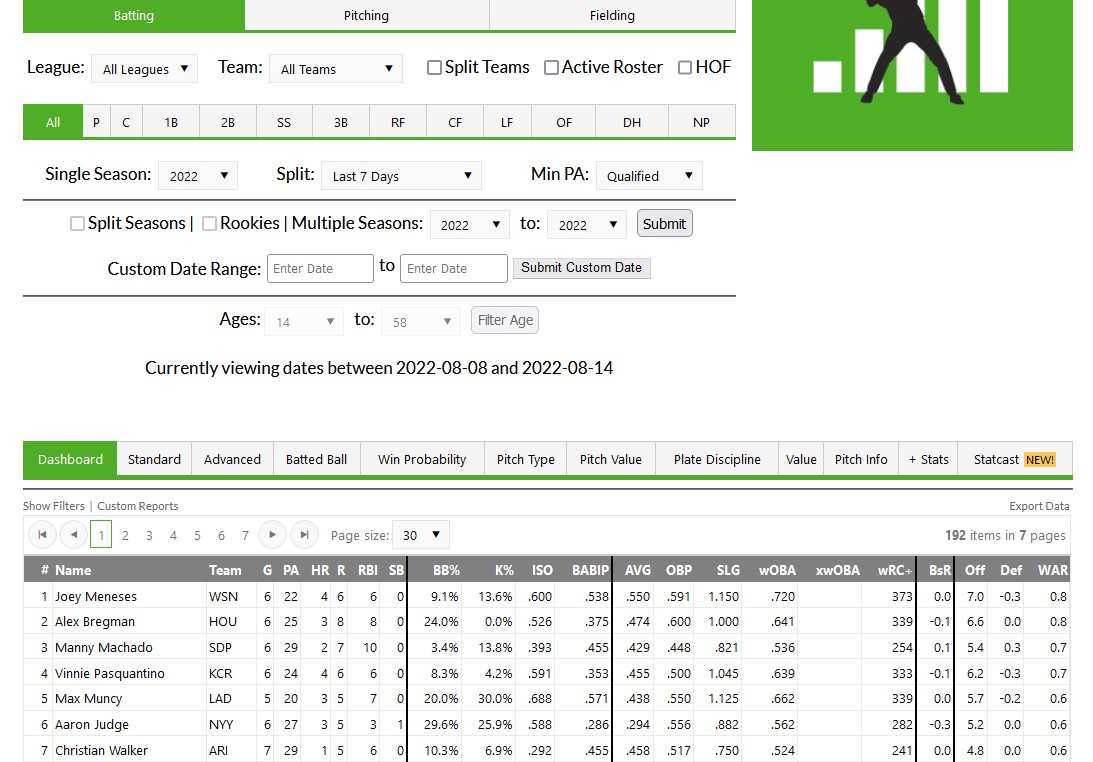
Pitcher of the month:
Kyle Finnegan (3–0, 1.50 RA/9, 11 G, 12 IP, 9.0 K/9, .298 opp OBP, 5.38 RE24, 0.7 RA9-WAR, 7 shutdowns, 1 meltdown)
Starter of the month:
Anibal Sanchez (1–2, 4.11 RA/9, 6 GS, 30⅔ IP, 5.6 K/9, .328 opp OBP, 0.5 RA9-WAR). While his first three starts weren’t good, over the last three he was looking like the pitcher we remember from 2019.
Worst month:
Shared by Steve Cishek (0–2, 9.90 RA/9, 13 G, 10 IP, 12.6 K/9, .408 opp OBP, –8.33 RE24, –0.5 RA9-WAR, 1 shutdown, 6 meltdowns) and Victor Arano (1–1, 9.22 RA/9, 14 G, 13⅔ IP, 9.9 K/9, .388 opp OBP, –9.13 RE24, –0.6 RA9-WAR, 2 shutdowns, 4 meltdowns).
Best start this month:
Anibal Sanchez (August 31, 5–1 win over the A’s at home) pitched 7 innings, giving up 1 run on 3 hits and 3 walks and striking out 4 for a game score of 68.
Worst start:
Shared by Patrick Corbin (August 6, 11–5 loss to the Phillies in Philadelphia), who gave up 6 runs on 5 hits and 2 walks in ⅔ inning, with no strike outs, for a game score of 16; and Cory Abbott (August 7, 13–1 loss to the Phillies in Philadelphia), who gave up 7 runs on 7 hits and 5 walks in 3⅔ innings, while striking out 2, for a game score of 16.
Tough losses:
- Erick Fedde (August 23, 4–2 loss to the Mariners in Seattle) gave up 2 runs on 3 hits and 1 walk in 5 innings, while striking out 6, for a game score of 58.
Cheap wins:
- None
Biggest shutdown:
Carl Edwards, Jr. (August 9, 6–5 win over the Cubs in Chicago) came into the game in the bottom of the eighth with two outs, a runner on second, and a 6–5 lead. He struck out Willson Contreras to get out of the inning. He came back for the ninth, got a strikeout, then gave up a single to Seiya Suzuki, who was caught stealing. After giving up a walk, he got his third strikeout to end the game. (Win probability added/WPA +.302)
Worst meltdown:
Steve Cishek (August 10, 4–2 loss to the Cubs in Chicago). The Nats were ahead 2–1 in the bottom of the seventh with one out and a runner on first when Cishek got the call to replace Josiah Gray. He gave up a walk, followed by an RBI single and a sacrifice fly. When he was lifted from the game after facing three batters, the Nats were trailing 3–2. (WPA –.416)
Clutch hit:
Joey Meneses (August 9, 6–5 win over the Cubs in Chicago). The Nats were trailing 5–4 in the bottom of the eighth, with two outs and a runner on first. Meneses lofted a home run past the ivy in left field to give the Nats a one-run lead. (WPA +.516)
Choke:
Maikel Franco (August 20, 2–1 loss to the Padres in San Diego). With one out in the top of the ninth, runners on first and second, and the Nats trailing 2 to 1, Franco got the call to pinch hit for Victor Robles. He hit a soft liner toward the first baseman. The runners froze, and first baseman Drury backed up a step to let the ball bounce. Drury then fired to second to get the force out, and the throw then went to third to tag the runner and get the double play. I’m not quite sure why the infield fly rule wasn’t written to cover this case, but the game was over. (WPA –.272) That turned out to be Franco’s last appearance in a game for the Nats, as he was released six days later.
Memorable hits:
- Nelson Cruz got his 2,000th career hit.
Memorable fielding plays:
- Victor Robles has his faults as a player, but no National is more likely to land an exceptional fielding play. He guns down a runner trying to stretch a double, makes a diving catch in the left-center gap, another diving catch in the right-center gap, and another charging in on a short fly to center.
- The Nats’ other center fielder, Lane Thomas, made a great throw to nail a runner at the plate.
- The new rookie shortstop, CJ Abrams, showed off his range with this fine play.
July was a dreary month for the Nationals. In the first 16 days they went 1–14. Most of these games were against divisional rivals, against whom they went 2–12 for the month. (Their cumulative record against the NL East opponents is now 8–36, compared to 27–32 against teams outside the division.) They finished July with a 6–19 monthly record for their worst month since April 2009. The month ended with the Nats’ record at 35–68, the worst in MLB. And as the month ended, the trade deadline loomed, which means the team is likely to be even worse in the last two months of this season.
The month began with the Nats at home playing a four-game series with the Marlins. Even though the Marlins didn’t start their Cy Young candidate, Sandy Alcantara, they still managed to sweep all four games from the hapless Nats. The home team managed to keep the last two games close but lost both of them in the tenth inning. The series ended with the Nats holding a 1–12 record against the fourth-place Marlins. For the home stand as a whole, the Nats’ record was 2–5.
Their next series was in Philadelphia against the Phillies. The series began with an 11–0 blowout loss to the Phils. The Nats managed to win the next game 3–2 but lost the finale. Their next series was in Atlanta, and it began with a 12–2 blowout loss to the Braves. The other two games were closer—one-run games—with the finale not decided until the twelfth inning, but the Nats were the losing team in all three games. Their record on the road trip was 1–5.
Returning home, the Nats had six games to play before the All-Star break. The first of two games scheduled against the Mariners was rained out, so they played both games the following day as a day-night doubleheader. The Nats lost both games, with a 2–1 loss coming in the nightcap. They then faced the Braves for four games. They lost the first three, giving them a nine-game losing streak (their longest since 2008), and losses in 15 of their last 16 games. But in the series finale, the last game before the All-Star break, the Nats rallied to win the game 7–3, letting them move to the break on a more hopeful note.
During that last weekend before the break, the news broke that Juan Soto had turned down the Nats’ last offer for a contract extension, and the team would be putting him on the trade market. Soto had made the All-Star team and was competing in the home-run derby, so he would face the full attention of the national media. With 17 days remaining until the August 2 trade deadline, the baseball news was full of trade rumors and speculation about possible trades.
The Nats’ only representatives at the All-Star game were Soto and Davey Martinez, who was designated as a coach under manager Brian Snitcker of the Braves. Martinez, of course, had missed his chance to manage the All-Star game after the team’s 2019 championship due to the 2020 pandemic, which led to the cancellation of that year’s game. Soto won the home run derby. It seemed eerily similar to the Nationals’ other home-run derby champion, Bryce Harper, who won in 2018, also shortly before leaving the team.
The first-year player draft also took place during the All-Star break. The Nats used their number 5 pick to draft 18 year-old outfielder Elijah Green and signed him a few days later. He’s described as hitting with power and having the speed and arm to play center field, and as having “the biggest upside of any player in this draft.”
After the break, the Nats had a western road trip, which opened with three games in Phoenix against the Diamondbacks. The series again opened with a blowout loss, this time by a 10–1 score. The Nats lost the first two games, but managed to win the finale by a one-run margin. Their next series was in Los Angeles against the Dodgers, who were on an eight-game winning streak and held the best record in baseball. In the opener, the Nats’ pitching (especially the relievers) kept the Dodger bats at bay, and the Nats won 4 to 1. They followed up the next evening with late rallies in the eighth and ninth innings for an 8 to 3 win, giving them their first series victory in four weeks. They lost the finale, finishing the road trip with a 3–3 record.
The month concluded at home with a series against the Cardinals, another team with playoff aspirations. The Nats won one of three, ending a largely miserable month that also featured several memorable games.
The Nationals were pretty awful all around. The starting pitchers in July had the worst ERA and ERA– in the National League and the worst fielding independent pitching (FIP) and FIP– in baseball. The batters were near the bottom (13th of 15 teams in the NL in weighted runs created, or wRC+) with only Juan Soto and Josh Bell hitting better than league average according to wRC+. The one bright spot for the team was the relief pitchers, whose 3.36 ERA in July ranked fifth in the NL.
Maybe the most devastating article I read on the Nationals this season was actually this article about the Orioles. It included an interview with Austin Voth, whom the Nats DFA’d after he pitched as a reliever in 19 games this season with a 10.13 ERA. With the Orioles for the last two months, he’s returned to starting and has a 2.84 ERA in 11 games. Voth said “I was kind of blown away by all the data that they have here, the video guys and how they can break down stats and pitches. And individually things for each pitcher. That was big for me.” The interview and Voth’s improved performance raises the question of just how bad the Nationals are at analytics, and how it may have led to disappointing performance by many talented young pitchers.
Two Nats pitchers, Tanner Rainey and Sean Doolittle, suffered elbow ligament injuries in July that likely ended their seasons. Doolittle had surgery that was less invasive than Tommy John surgery to repair a partial tear and faces a five-to-seven month recovery period. So far, there’s no word that Rainey will need surgery for his elbow ligament strain, but he was placed on the 60-day injured list and is reported to be out for the remainder of the season. Jackson Tetreault suffered a right scapula stress fracture and also went on the 60-day injured list.
In other personnel moves, the Nationals picked up 2023 contract options for Mike Rizzo and Davey Martinez, allowing both the general manager and the manager to remain in place for another season as ownership continues to explore the sale of the team. Anibal Sanchez returned to the starting rotation for the first time since 2020—he sat out the 2021 season and was on the injured list for the first three and a half months of 2022 due to cervical nerve impingement. Departing the team in July was Sam Clay, who was claimed off waivers and is now with the Mets.
Record:
6–19 (.240)
Pythagorean Record:
6–19 (3.12 R/G – 5.48 RA/G)
July MVP:
Juan Soto (.315/.495/.616, 6 HR, 17 R, 13 RBI, 205 wRC+, 1.2 fWAR)
Pitcher of the month:
Kyle Finnegan (0–0, 1.64 RA/9, 9 G, 11 IP, 6.5 K/9, .162 opp OBP, 5.09 RE24, 0.7 RA9-WAR, 5 shutdowns, 1 meltdown)
Starter of the month:
Erasmo Ramirez (As a starter: 0–0, 0.00 RA/9, 1 GS, 3 IP, 6.0 K/9, .100 opp OBP, 0.2 RA9-WAR). Okay, this is kind of a joke award, given that Ramirez was a reliever who made just the one 3-inning start. The point, though, is that none of the actual starters deserved an award. The lowest ERA in July of the Nats’ seven “actual” starters was 5.82 (by Paolo Espino). All of the other starters had ERAs ranging from 6.75 to 9.00. That is not award-worthy performance.
Worst month:
This one is shared by Patrick Corbin (0–4, 8.36 RA/9, 5 GS, 22⅔ IP, 8.7 K/9, .409 opp OBP, –0.6 RA9-WAR) and Nelson Cruz (.173/.253/.213, 0 HR, 5 R, 7 RBI, 35 wRC+, –0.6 fWAR). Cruz’s poor performance in July may have cost him a trade to a contender before the deadline (written with about four hours to go before the deadline).
Best start this month:
Josiah Gray (July 6, 3–2 win over the Phillies in Philadelphia) pitched 6 innings, giving up 2 runs on 4 hits and 1 walk and striking out 11 for a game score of 66.
Worst start:
Erick Fedde (July 8, 12–2 loss to the Braves in Atlanta) gave up 8 runs on 8 hits and 3 walks in 3+ innings with 1 strikeout for a game score of 9.
Tough losses:
- None
Cheap wins:
- None
Biggest shutdown:
Tanner Rainey (July 10, 4–3 loss to the Braves in 12 innings in Atlanta) pitched the 10th and 11th innings of a game that was tied 3–3 and held the Braves scoreless. He gave up a 2-out single in the 10th, but automatic runner Austin Riley was thrown out at the plate trying to score. The Braves also got a one-out single in the 11th, but were unable to score either runner. (Win probability added/WPA +.635)
Worst meltdown:
Tanner Rainey (July 3, 7–4 loss to the Marlins at home). The Nats were ahead 3–2 in the top of the ninth when Rainey was asked to get the save. He got a strikeout and a ground out, but then walked Avisail Garcia. With a 2–2 count, Jesus Sanchez hit a home run to give the Marlins the lead. (WPA –.629) The Nats tied the game in the bottom of the inning, but Carl Edwards Jr. gave up 4 singles and 3 runs in the top of the 10th, and the Nats were unable to score in the bottom of the inning.
Clutch hit:
Luis Garcia (July 26, 8–3 win over the Dodgers in Los Angeles). Garcia came to bat in the top of the eighth with two outs, a runner on first, and the Nats were trailing 3–2. He hit a 1–2 hanging breaking ball into the right field bleachers, giving the Nationals the lead. (WPA +.536) The Nats tacked on 4 runs in the top of the ninth to guarantee the win.
Choke:
Luis Garcia (July 4, 3–2 loss to the Marlins at home). The Nats and Marlins were tied 1 to 1 at the end of nine. In the top of the tenth, Bryan De La Cruz hit a 2-run homer to give the Marlins a 3–1 lead. In the bottom of the inning, Ehire Adrianza led off with a single, advancing the automatic runner to third. So, Garcia came to bat with no outs and runners on first and third. He grounded into a 4–6–3 double play, scoring the runner from third but leaving two outs and the bases empty. (WPA –.319) The Nats got one more single before the Marlins got the final out.
Memorable fielding plays:
Victor Robles may have misjudged this fly ball off the bat, but he recovered to make a fine play.
 Nats Noodles